
An OMB® AES module
Your LinkedIn stops being a social network
and becomes a sales machine.
For the record
We operate your accounts with more and better filters and generate real, authentic conversations from your own accounts. The opportunities that reach you are real.
OMB has operated on LinkedIn without interruption since 2012. Every criterion that governs the system today traces back to a real conversation: the invitation that opened a corporate account and the one that never got a reply, the message that secured the meeting and the one that arrived late, the two-year silence that still allowed a second chance. Thousands of successes and a few mistakes, which are the ones that leave the most valuable lessons.
That is why it is neither a generic tool that has to be taught how to sell, nor an agency that scales by adding hands. It is a proven method, translated into code, operating with judgment of its own on your team's accounts.
End-to-end automation
Six chained stages that run on their own. None of them depends on someone remembering to execute it.
The platform
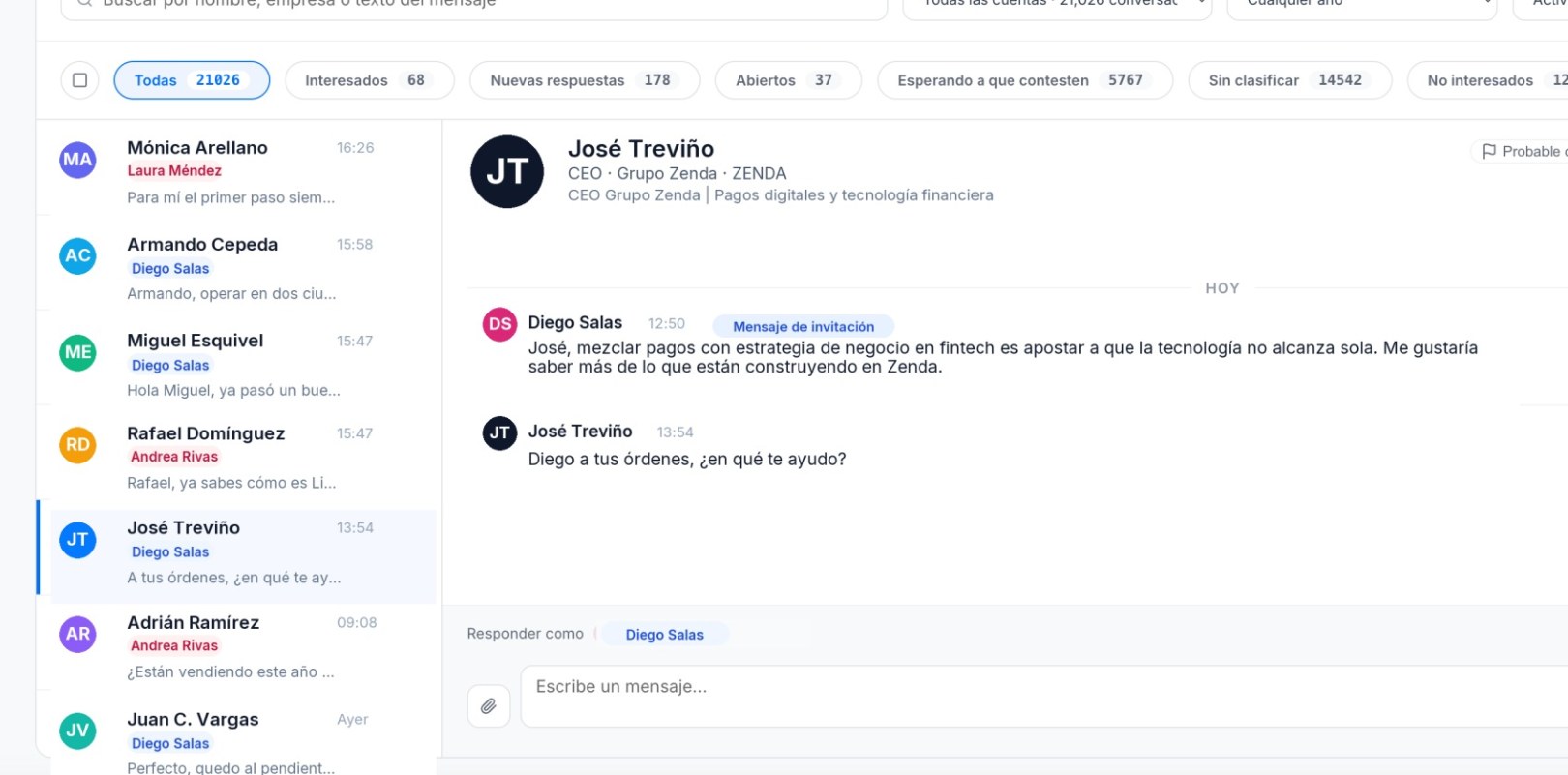
Today each salesperson runs their own account and nobody has visibility of the whole. Here the conversations from every account arrive on the same screen, with their full history, searchable by name, company or the content of the message.
And they arrive classified: who showed interest, who replied lukewarmly, who is waiting on a reply from you and who is better left alone.
For years you had to choose between two paths. Write little and well, with a team that never managed to cover the market. Or write a lot from a template, and watch the response rate fall along with the account's reputation. Artificial intelligence dissolves that dilemma.
Excellent message, minimal reach, and an operation that stops the moment the salesperson has a demanding week.
Broad reach, marginal response rate, and an account that starts collecting reports.
Every note is written around what that person does, where they work and what was said before. There is no template to fill in: there is a different message for each contact, and all of them get sent.
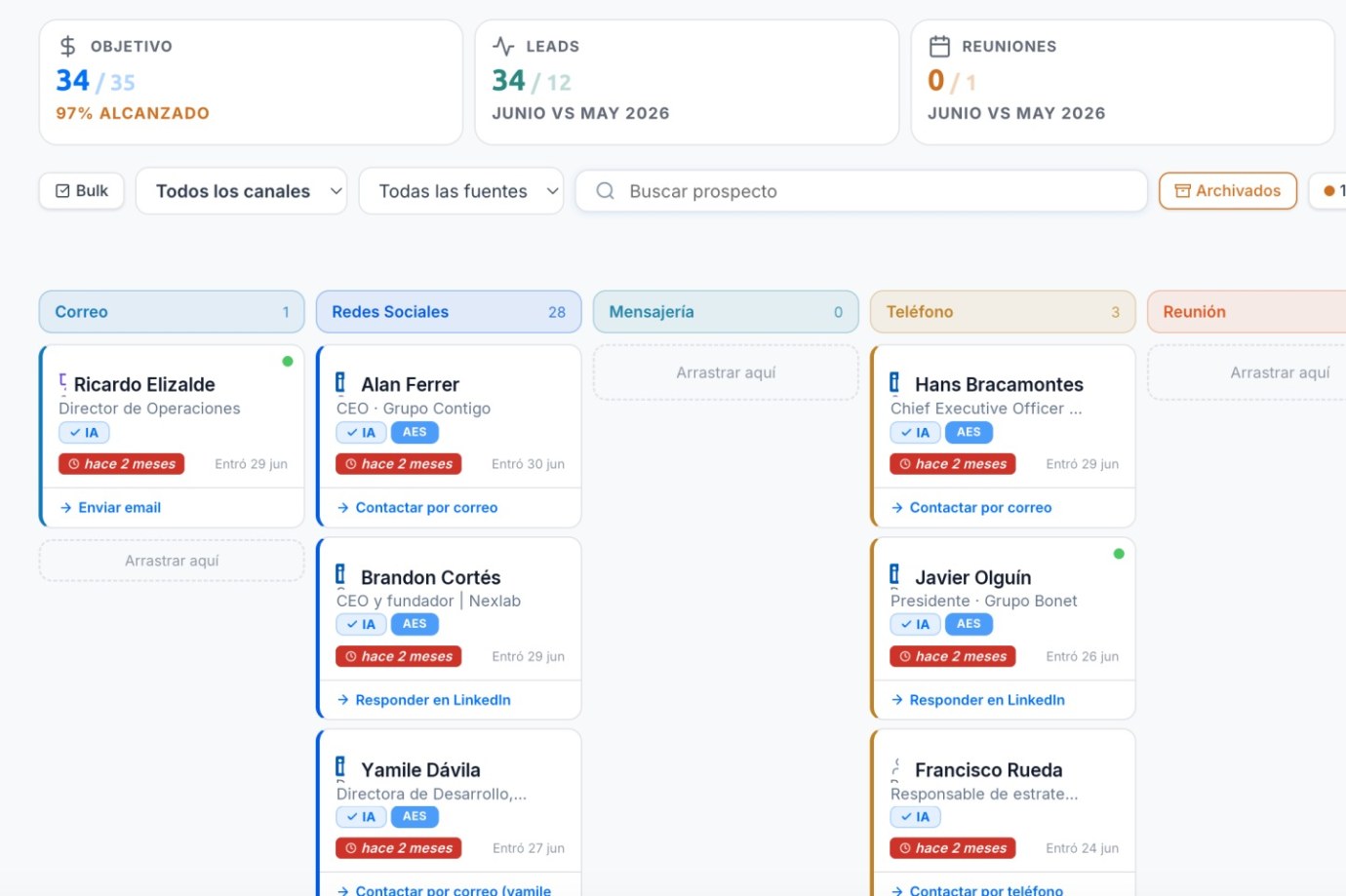
The prospect is created automatically inside the OMB AES CRM, with the full conversation on its record. No exports, no manual data entry: it is the same record viewed from another screen, which is why nothing gets lost between one tool and the next.
And from there, on to the close
When someone asks for a call or shares their number, the assigned salesperson gets it instantly, with a link to the conversation. It doesn't wait for Monday's report.
Whatever market you sell into, it writes in the right language and the right regional tone. It isn't a translation: it is a different piece of writing.
When the conversation matures, your sales director is brought in as exactly what it is: a step up in the level of attention. Whoever opened the relationship stays on to coordinate.
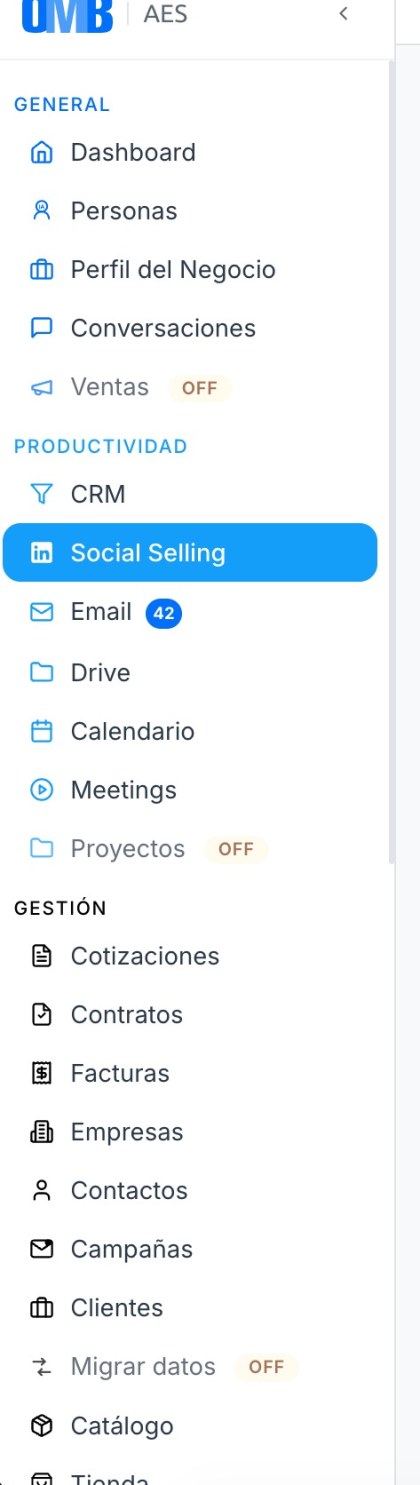
Social Selling is not a standalone tool: it is a module of OMB® AES, the system where your whole operation lives. The CRM is another module of the same system, which is why the prospect and its conversation are literally the same record.
That is something no integration between two separate products can offer. And it means that the day you decide to expand the scope, the capacity is already there, with no migrations.
They are enabled according to the plan you subscribe to. There is no need to adopt all of them from day one.
Your network
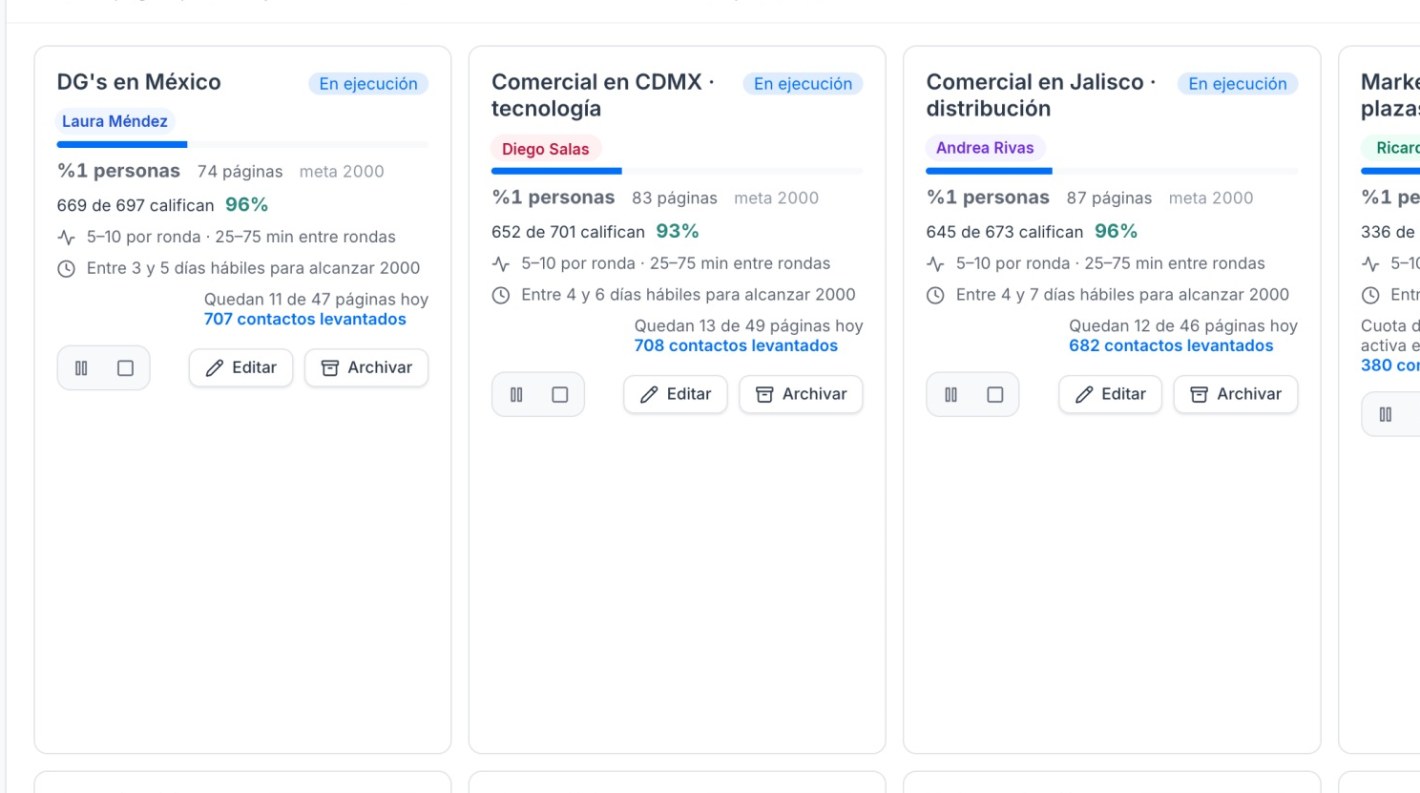
If your team has been on LinkedIn for years, it has accumulated thousands of contacts who accepted the connection and never had a conversation. Permission has already been granted. It is the asset with the lowest acquisition cost, and the one almost no company works.
This applies especially to accounts with an established network. And to make the most of it you need filters that neither LinkedIn nor Sales Navigator offers, because neither knows your history with that person.
The module runs on your team's accounts, so each company purchases its own license. There are two scenarios, and it is worth settling this from the start because it changes the budget.
Required if you need to filter by company size, which in B2B is usually the deciding criterion. It is the full segmentation option.
If company size isn't decisive in your case, this license is enough and covers two accounts. It is the alternative with the lowest initial investment.
There is only one criterion: if your sale requires telling the hundred-employee company apart from the ten-employee one, you need Sales Navigator, because company size is the only filter LinkedIn reserves for that license. If your buyer is defined by title, industry or city, Premium is enough and the investment drops considerably.
Each company purchases the license and it is not included in the monthly fee.
Value proposition
Your LinkedIn license knows which company a person works for and what their role is. OMB AES starts there and adds what only exists in your history: when you connected, what was said and who asked you to reach out later. With artificial intelligence, that memory becomes the criterion that decides who you write to today and with what argument.
The marked criteria come from your LinkedIn license, and OMB AES uses them as they are: it segments by reading your team's LinkedIn accounts, so everything your license already knows, the system puts to work. You purchase the license and it is not included in the monthly fee. The six layers below need no additional license: they come from your history, which is already yours.
Your license brings the first four criteria.
OMB AES adds the other six with artificial intelligence, and together they decide.

The three judgment calls an experienced salesperson makes without thinking, and that no tool had managed to replicate.
The craft
It is what separates a message that gets a reply from one that gets ignored. The system measures the accumulated silence and completely adjusts the opening.
There is no delay to acknowledge. Mentioning the time elapsed would suggest the hours are being counted. You answer and propose the call.
One sentence that acknowledges the delay and moves on. No lengthy apologies: acknowledge, yes; justify, never.
At that distance the memory is hazy. The context is restored in a few words, without assuming they should remember it, and you ask about their current situation.
At this distance you don't explain why there was no reply: that explanation is unnecessary and makes the message about the writer. They may not place you, they may have changed companies, and the reason for that old conversation may no longer exist. Nothing is sold here: the relationship is rebuilt.
Your account
Having an artificial intelligence write in your name only works if trust is built in stages. That's why it isn't an all-or-nothing decision.
The system researches, decides who is worth opening a conversation with and drafts the message. You review it and approve it, edit it or discard it. Nothing is sent without your authorization.
It runs autonomously. And it isn't switched on all at once: it is released by lanes, one at a time, starting with the lowest-risk one.
Even in automatic mode there are decisions that are always run by you: when someone shares their phone number, when they ask for a quote or when the conversation takes a delicate turn.
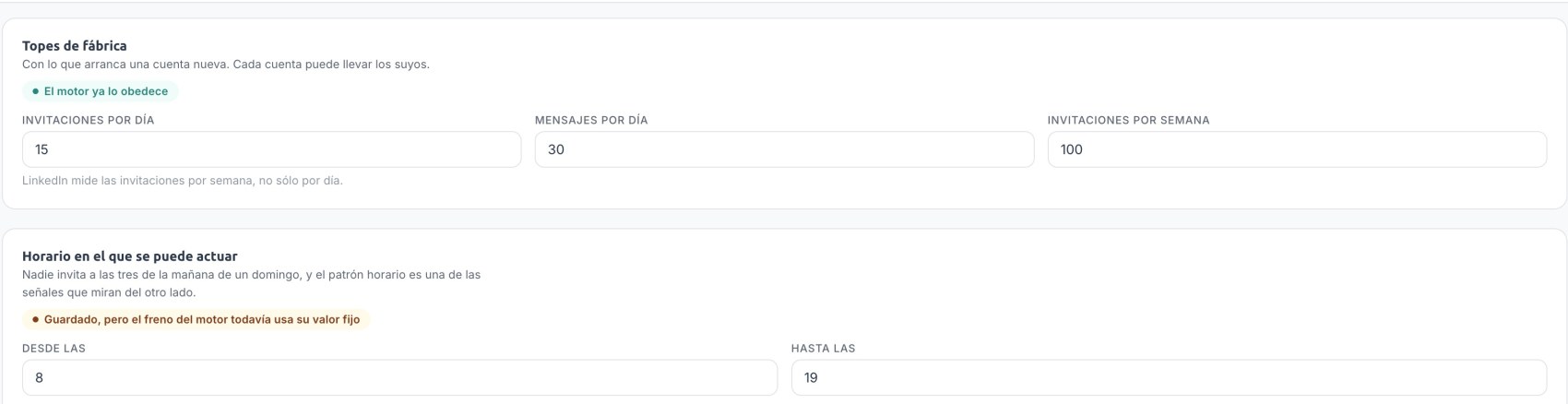
It is the first question we get asked, and rightly so: a LinkedIn account represents years of network building. That's why the system operates with the caution of an experienced professional, and every limit is in plain sight for you to adjust.

We connect your accounts and the system mirrors the conversations. Within the first week you have the list of those who showed interest and are still waiting for a reply, without having sent a single new message.
+52 56 6387 6979
