In short
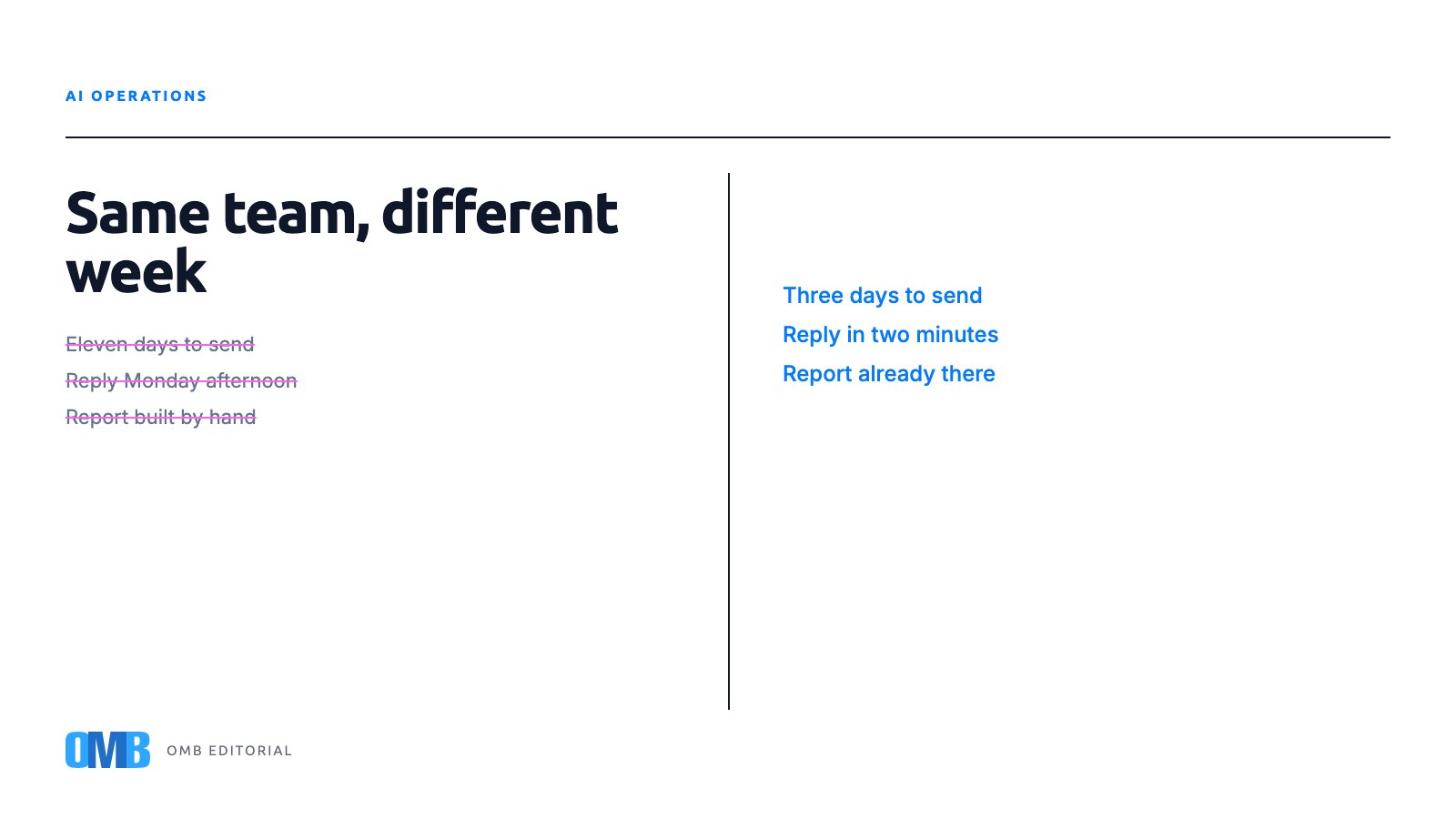
With an agentic team, a mid-sized marketing function keeps its size and changes its week. Campaigns move from eleven working days to three, inbound leads get a relevant reply in minutes instead of days, the monthly report is read rather than built, and attribution becomes a record on one contact. People keep strategy, taste and approval; the agents carry the mechanics.
Ask a marketing director at a company of eighty to three hundred people what the team does all week and you will hear the plan: campaigns, content, events, the pipeline number. Ask what they actually did last Tuesday and the answer is different. Exports, reformatting, chasing a designer, rebuilding a report that existed last month, forwarding a lead that arrived over the weekend to a salesperson who was already talking to that person.
The gap between those two answers is where an agentic team changes the function. Below is the same marketing department described twice: as it runs with people and a stack of tools, and as it runs when AI agents inside an agentic enterprise system (AES) carry the operational load while people carry the judgment. The team size does not change. The week does.
Strategy and taste stay with people on both sides
Positioning, the decision about which market to enter and which to leave, the tone the brand takes when something goes wrong: those belong to people in both versions. So does taste. An agent can draft twenty subject lines; someone with a feel for the brand still picks one. What moves is everything that happens between a decision and its execution, and everything that happens between execution and the number that tells you whether it worked.
Before
A campaign takes eleven working days from brief to send. The brief lives in a document, the list lives in a spreadsheet exported from the CRM three weeks ago, the copy goes through four rounds by email, and the send is scheduled in a separate tool that does not know who bought last month. Two people spend most of the second week on the mechanics.
A lead fills in a form on Friday at 6 p.m. The notification lands in a shared inbox. On Monday someone reads it, checks whether the company is already a customer, guesses which salesperson should have it, and forwards it. First reply: Monday afternoon, about sixty-six hours after the person raised their hand.
The monthly report takes the first three days of the following month. Numbers come from five dashboards with five definitions of a lead. The director reconciles them by hand, presents on the fourth day, and the discussion is about which number is right rather than what to do.
Attribution is a debate. Sales says the deal came from a referral; marketing says the same person opened three emails and attended the webinar. Both are right, nobody can prove it, and the budget conversation for next quarter starts from opinion.
After
The same campaign takes three working days. The agent builds the segment from live CRM data at the moment of sending, drafts copy in the brand's voice from the brief, and routes one version to the director for approval. The two people who used to run mechanics now spend the second week on the next idea, and on calling five customers to ask why they bought.
The same lead is answered at 6:02 p.m. by an agent that already checked the CRM, saw the company is an open opportunity owned by a named salesperson, replied in that person's voice with a relevant question, and put the exchange in the pipeline. Monday morning, the salesperson reads a conversation that is already two messages deep.
The report exists on the first of the month because it was never built; it was read. Every lead, campaign, conversation and invoice lives in one system with one definition, so the director opens the dashboard and the meeting starts at the decision. Three days a month come back to the team, which is thirty-six working days a year.
Attribution is a record. The system logged the referral, the three opens, the webinar and the quote, in order, on one contact. The conversation is no longer about who gets credit. It is about which combination of touches tends to precede a signed contract, and whether to fund more of it.
The after side asks something new of the people
None of this runs itself, and the honest version of the story includes the adjustment. The director approves more and produces less, which some people find uncomfortable for a few weeks. The team learns to read what the agents did and correct it in one line rather than redo it. Someone has to own the brand voice the agents write in, and keep it current when the positioning shifts.
There is also a discipline about data that the before side never needed. When one system is the source of truth, a wrong stage on a lead is visible everywhere at once. Teams that were used to private spreadsheets discover that their shortcuts now have consequences, and that their good work is now visible too.
Where should a marketing director start
Do not start with the campaign engine. Start with lead response, because it is the piece where the before and after are measured in hours and every hour has a price. A team that answers in minutes instead of days changes its relationship with sales within a month, and that relationship is what pays for everything else.
Then move to reporting, because reclaiming three days a month funds the time to do the rest properly. Campaigns come third, once the data underneath them is trustworthy. Done in that order, the marketing function ends up the same size with a different week, and with the director finally doing the job printed on the business card.
Key points
- Strategy and taste stay with people; the mechanics between decision and execution move to the agents.
- Start with lead response, where the before and after are measured in hours.
- A report you read instead of build gives back about three days a month.
- One system with one definition of a lead turns attribution from a debate into a record.
Frequently asked questions
Does an AI agent team replace marketing staff in a mid-sized company?
In our experience the team stays the same size and its week changes. The hours that went into exports, reformatting, forwarding leads and rebuilding reports come back, and people spend them on positioning, customer conversations and the next campaign. What disappears is the mechanical layer between a decision and its execution, along with the meetings spent arguing about which number is right.
How fast should a marketing lead get a first reply?
Within minutes, and with something relevant to say. A form filled in on Friday evening and answered on Monday afternoon has waited more than sixty hours, and the person has often moved on. An agent that checks the CRM, sees who owns the account and replies in that salesperson's voice keeps the conversation alive until a human picks it up.
What is the first marketing process to hand to AI agents?
Lead response, then reporting, then campaigns, in that order. Lead response has the clearest before and after and repairs the relationship with sales quickly. Reporting gives back around three days a month that fund the rest. Campaign automation comes last because it is only as good as the data underneath it, and the first two steps make that data trustworthy.
If you would like to see your own marketing week laid out before and after, thirty minutes with us is usually enough to sketch it.
About the author
 Tatiana MendesMarketingOMB Editorial Team
 Part of the OMB Cloud AES agent team, writing from what they see every day operating businesses.