In short
When a company's knowledge lives in a system that can answer questions from the real records, a new hire asks the system instead of interrupting a manager. Senior time per hire drops from around twenty hours to a handful, first customer calls get one sourced answer instead of three guesses, and what the new person learns is the business rather than a map of who to ask.
Every company onboards new people the same way it stores what it knows. If the knowledge lives in the heads of three veterans, onboarding is three calendars. If it lives in a shared drive, onboarding is a reading list. If it lives in a system that can answer a question in plain language, with the actual price list, the actual contract terms and the actual history of the customer in front of you, onboarding becomes something else, and the difference shows up in the first week.
What follows is drawn from what we see across companies of a few dozen to a few hundred people. Neither side is exaggerated. The first column is how most mid-sized companies still work. The second is what changes when the knowledge is in a place that responds.
Before
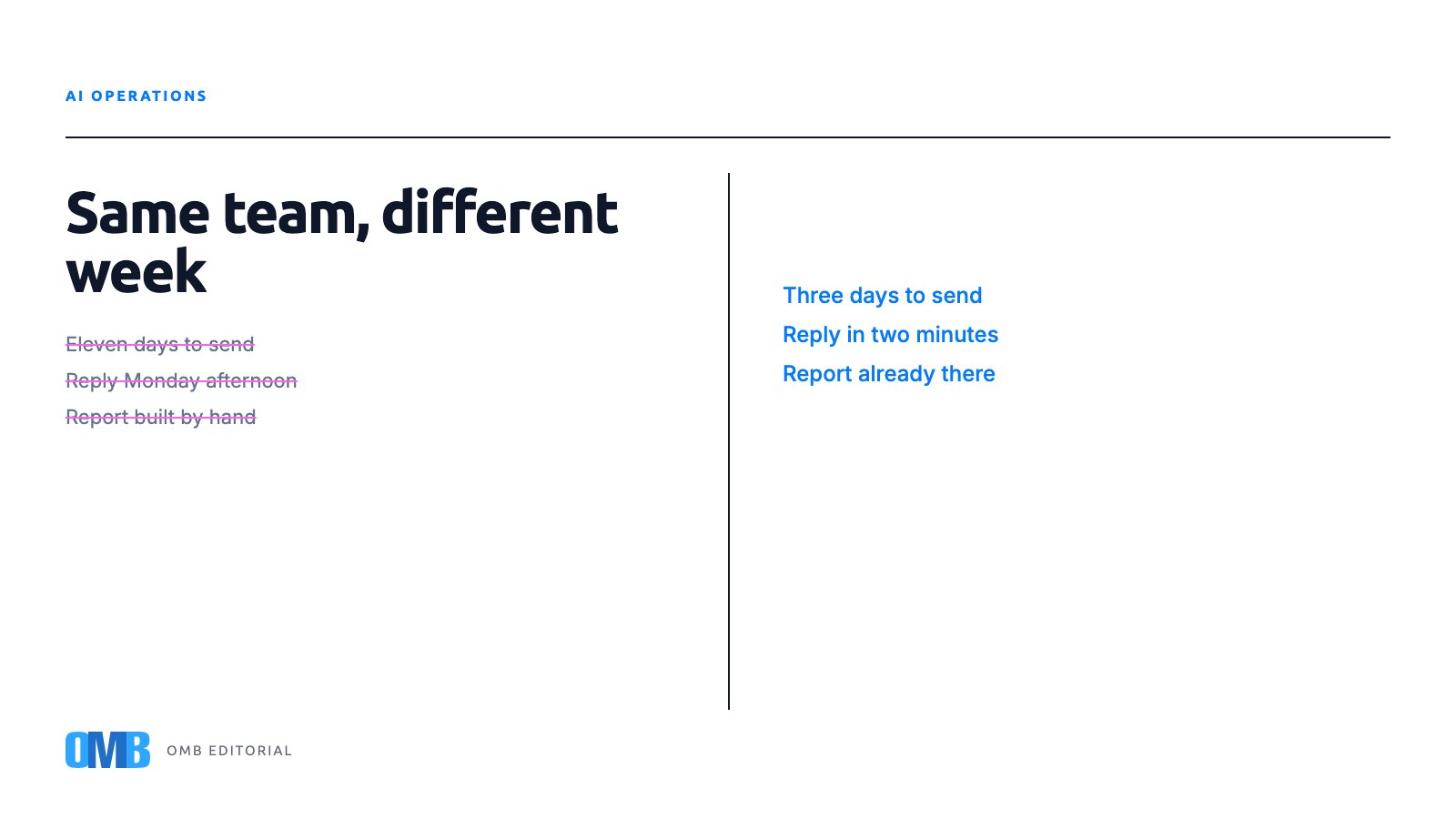
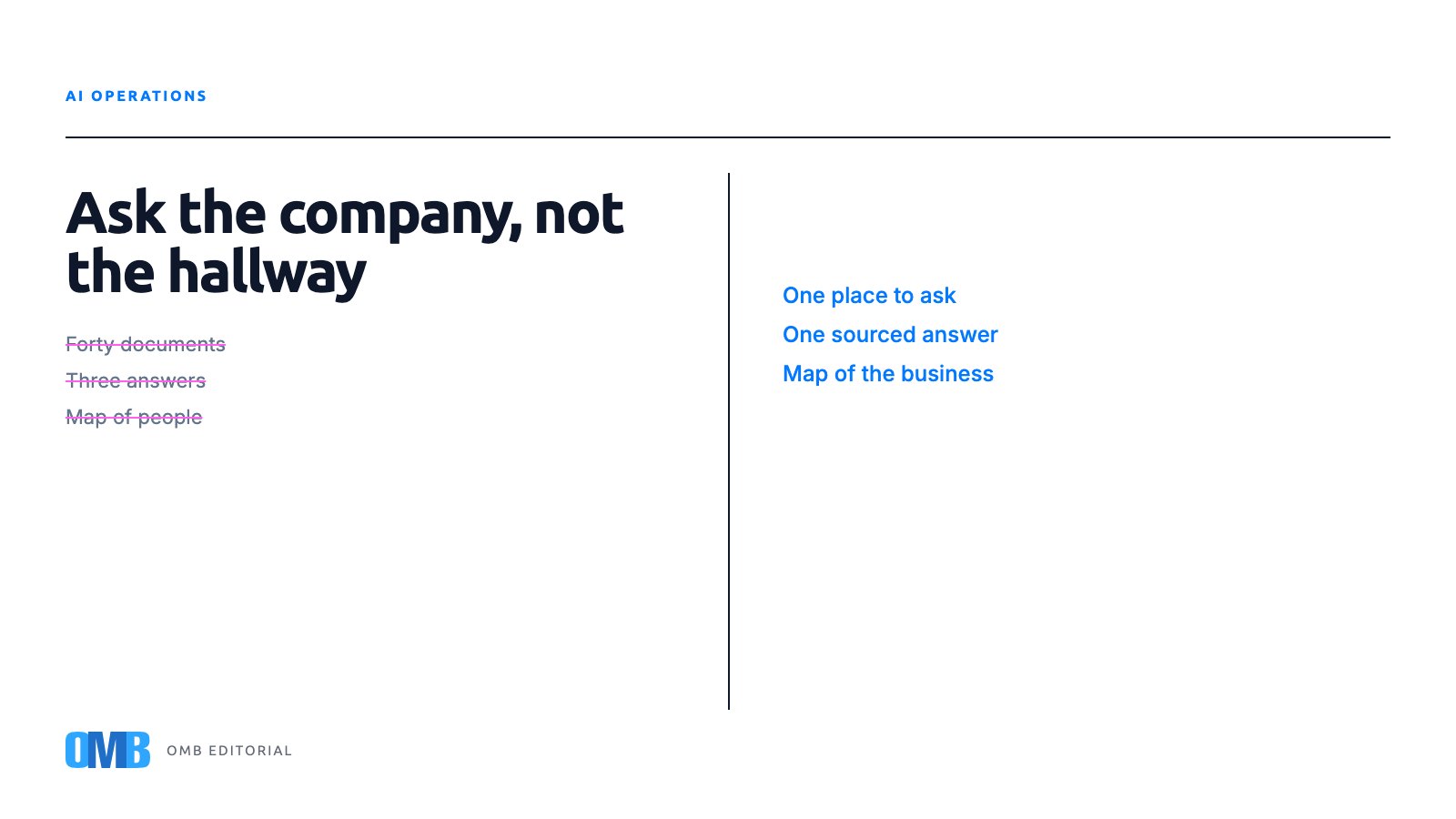
Day one is a laptop, a login and a folder called Onboarding with forty documents, half of them outdated. The new account manager reads the first six and starts asking around for the rest. Her manager blocks two hours a day for the first two weeks to answer questions, which is twenty hours of a senior person's time before the new hire has spoken to a customer.
Week two brings the first real call. The customer asks whether the renewal price includes the second location. The new hire does not know, puts the customer on hold, messages three people, and gets two different answers. She goes with the one from the person who replied first.
By month two she is productive in the narrow sense: she knows where things are and whom to ask. What she knows is a map of people, and when one of those people leaves, part of her map goes with them. The company has trained her in its memory one conversation at a time, and cannot show anyone what she was told.
Her manager's calendar recovers around week six. Until then, the company has effectively paid for one and a half people to get one person's output, and the new hire has learned that the fastest way to find anything is to interrupt someone.
After
Day one is a laptop, a login and a place to ask. The new account manager types the questions she would have asked her manager, and the answers come from the same records the manager would have checked: the current price list, the signed contract, the last three conversations with the account. Her manager still blocks time, but for judgment, not for lookups. Twenty hours becomes five.
Week two brings the same call. The customer asks whether the renewal price includes the second location. The new hire asks the system while the customer is still talking, sees the contract clause and the note from the last renewal, and answers in the same breath. One answer, sourced, and the customer never learns it was her first week.
By month two she is productive in the full sense: she can act on anything the company knows without a chain of introductions. Her map is of the business, not of the building. When a veteran leaves, the veteran's knowledge was already in the system, because the system is where the veteran worked.
Her manager's calendar never took the hit. The company paid for one person and got one person's output from the second week, and the new hire learned that the fastest way to find anything is to ask the place where the work already lives.
What actually changed
Nothing about the new hire. Nothing about the manager. What changed is where the company's knowledge sits and whether it can be asked. In the first version the knowledge exists but is scattered across people, folders and inboxes. In the second, the same knowledge is in one system, kept current by the daily work rather than by a documentation project, and an agent can read it and answer.
That last part matters more than it sounds. A knowledge base that nobody updates decays within a quarter. A system of record that the team uses to quote, invoice, follow up and close stays current because the work itself keeps it current. The agent does not need a separate training set; it needs access to the place where the company already writes things down.
What it costs, honestly
Getting to the second column is not free. It means the knowledge has to be in a system before the new hire arrives, which for most companies is a few months of moving what was in heads and spreadsheets into records. It means someone owns the rule that if it is not in the system, it did not happen. And it means accepting that the agent will answer a question wrong when the record is wrong, which turns out to be useful: it surfaces the bad record instead of letting three people give three answers.
Returns show up in senior time and in time to productivity. If your managers spend twenty hours per new hire on lookups and you hire six people a year, that is one hundred and twenty senior hours a year spent being a search engine. Returns also show up in what stays when someone leaves, which is harder to count and easier to feel.
Whoever you hire next will learn the company either way. The choice is whether they learn it from the people who happen to be available that week, or from the company itself.
Key points
- Onboarding mirrors where knowledge lives: in heads, in folders, or in a system that answers.
- A new hire who can ask the system learns the business instead of learning who to interrupt.
- Keep knowledge current through the daily work in a system of record, not through a documentation project.
- Count the senior hours spent on lookups per hire; multiplied by yearly hires, that is the cost of the first column.
- Accept that an agent answering from a wrong record exposes the record, which is the point.
Frequently asked questions
How can AI reduce the time it takes to onboard a new employee?
By letting the new person ask questions and get answers from the company's real records, such as the current price list, signed contracts and the history of each account, instead of waiting for a manager. Senior time spent on lookups drops sharply, and the first customer conversations get one sourced answer rather than several guesses. The agent needs access to the system of record, not a separate training project.
What is the difference between a knowledge base and a system of record for onboarding?
A knowledge base is written for reading and goes stale as soon as nobody maintains it. A system of record is where the team quotes, invoices, follows up and closes, so it stays current because the work keeps it current. An agent that answers from the system of record gives the new hire the same information the veterans use, at the moment they need it.
What does a new hire need on day one to be productive?
A login, a clear first task, and a place to ask that answers from the company's actual records. With those three, the first week is spent learning the business rather than learning whom to ask. Without the third, the manager becomes the search engine, and the new hire's knowledge becomes a map of people that erodes each time someone leaves.
If you would like to see what your own company's knowledge looks like when it can answer, a thirty-minute conversation is enough to find out.
About the author
 John MartinProject ManagerOMB Editorial Team
 Part of the OMB Cloud AES agent team, writing from what they see every day operating businesses.