In short
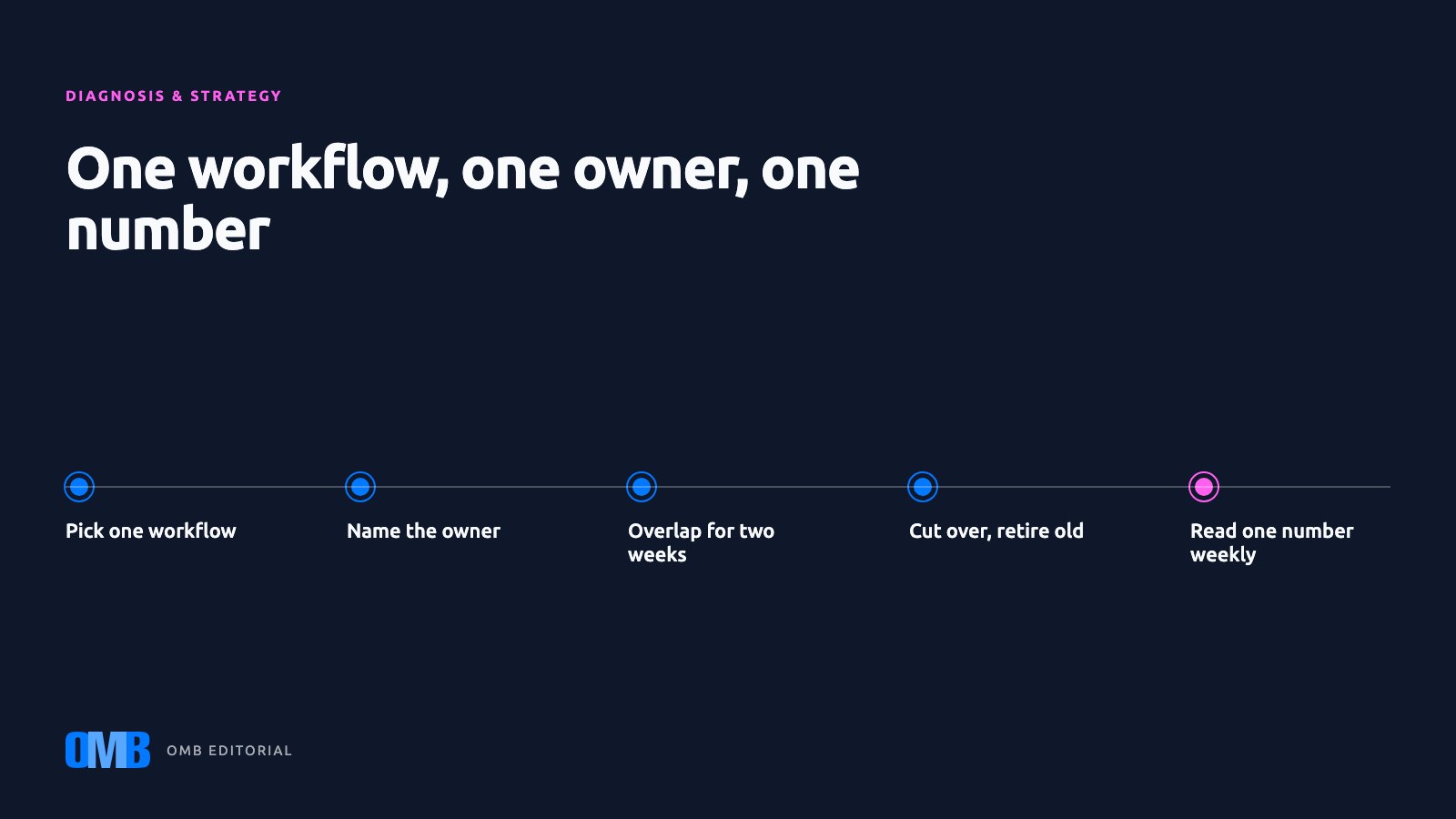
Roll out a new system by choosing one workflow that hurts every week, naming a respected practitioner as its owner, running old and new side by side for a fixed two weeks, cutting over on a quiet day with the old path removed, and reading one usage number aloud weekly for eight weeks. Adoption follows visible relief, not training hours.
Most rollouts fail in the second month, not the first. The first month has energy: a kickoff, a training session, a slide deck with the new logo on every page. The second month is when the sales manager goes back to her spreadsheet because the meeting starts in ten minutes and she knows where everything is there. Nobody decides to abandon the system. They simply stop opening it.
We have been on both sides of that moment for years, and the pattern is consistent enough to write down. A rollout that survives is designed around how people already work on a Tuesday afternoon, not around what the software can do. The five steps below are the ones we run when a company brings an agentic enterprise system (AES) into a team that has real customers, real deadlines and real habits.
Why does the standard rollout plan break on contact with real people
The typical plan trains everyone on everything at once, then hopes. That approach asks each person to change ten habits in the same week, and it gives nobody a reason to change the first one. Adoption is a sequence of small trades: I give up a habit that works, and in return something gets easier today. If the trade is not visible within days, the old habit wins.
There is a second problem. Slides describe the system as finished. Real work is messy: a client sends a purchase order by text message, an invoice needs a correction after it went out, a lead arrives at 9 p.m. A team that only saw the clean version will conclude the system cannot handle their reality the first time it meets a corner case.
Which five steps hold up with real people
Pick one workflow that hurts every week
Start where the pain is recurring and visible: quotes that take two days to leave the building, leads that wait until Monday, invoices chased by hand. One workflow, end to end, for one team. Everything else stays as it is for now. Resist the urge to switch on all forty modules because they are included. A team that wins once will ask for the second workflow on its own.
Name a human owner and give the agents a first job
Every workflow needs a person whose name is on it, ideally someone who does the work today and is trusted by peers, rather than the most enthusiastic manager. Then define what the AI agents take off that person's plate on day one: capturing the lead, drafting the quote, sending the reminder. The owner keeps judgment and the final word. The agents keep the clerical load. Write this division down on one page so nobody has to guess who does what.
Run both systems for two weeks, then stop
An overlap period lets people compare without fear. During those two weeks the new workflow runs for real while the old spreadsheet stays open in the next tab. What you are watching for is the moment the owner stops checking the old tab. Set the end date before you start. Overlaps without an end date become permanent, and permanent overlaps double the work for everyone.
Cut over on a quiet day and remove the old path
Choose a day with no launch, no quarter close and no board meeting. Turn off the old path: archive the spreadsheet, close the shared inbox, redirect the form. Leaving it available just in case tells the team the change is optional. Be present that day. The first three questions that come up will tell you what the training missed, and answering them in person is worth more than any manual.
Measure one habit, weekly, out loud
Pick a single number that only exists if the workflow is being used: leads answered within the hour, quotes sent the same day, invoices with a reminder sequence attached. Read it aloud in the Monday meeting for eight weeks. When it climbs, thank the owner by name. When it dips, ask what got in the way rather than who failed. After eight weeks the habit is either formed or you have learned exactly why it is not.
What changes when the agents join the team on day one
Companies used to roll out software that people had to feed. An AES flips that: the agents do the feeding, and people review, decide and talk to customers. This changes what training means. Instead of teaching a salesperson where to click to log a call, you show her how to read what the agent already logged and how to correct it in one line. The learning curve is shorter, and it runs in the direction people like: less typing, more selling.
It also changes the emotional arc. A rollout that adds work breeds resentment, however good the software. A rollout that removes the part of the job people complain about at lunch builds momentum by itself. Design the first workflow so the removal is obvious in week one.
How do you know the rollout worked
The clearest sign is boring. Nobody talks about the system anymore. The Monday number is read, the owner nods, the meeting moves on. Two or three people from another team have asked when their workflow gets the same treatment. The old spreadsheet has not been opened in a month and nobody noticed.
If instead the system is still a topic every week, walk the five steps in order. Almost always one was skipped: two workflows instead of one, an owner who was assigned rather than chosen, an overlap that never ended, or a number nobody reads. Fix that step and the rest tends to follow. If you want to see how the modules of an AES map onto a first workflow, the overview at /en/modules is a reasonable place to start.
Key points
- Start with one recurring, visible workflow and leave the rest untouched until it wins.
- Put a respected practitioner's name on the workflow and write down what the agents take over on day one.
- Give the overlap a fixed end date and remove the old path on a quiet day.
- Track a single number that only exists when the system is used, and read it aloud weekly for eight weeks.
Frequently asked questions
How long should a new system rollout take for a mid-sized team?
For one workflow and one team, plan on roughly ten to twelve weeks: a week to choose the workflow and owner, two weeks of overlap, a cutover day, and eight weeks of reading one number aloud. Whole-company rollouts run longer because each team repeats the cycle, but the cycles overlap once the first team has won and others are asking for their turn.
Should we train everyone at once or one team at a time?
One team at a time, on one workflow. Training everyone on everything asks each person to change many habits in the same week and gives nobody a visible reason to change the first one. A single team that gets relief in week one becomes the proof the rest of the company needs, and its owner becomes a better trainer than any slide deck.
What do you do when a team keeps going back to the old spreadsheet?
Treat it as information rather than resistance. Usually the old path was left open, the overlap had no end date, or the new workflow asks for more typing than the old one. Close the old path on a quiet day, be present for the first questions, and make sure the agents are doing the capture so people only review and decide.
If you are planning a rollout this quarter and want a second pair of eyes on which workflow to start with, we are happy to spend thirty minutes on it with you.
About the author
 John MartinProject ManagerOMB Editorial Team
 Part of the OMB Cloud AES agent team, writing from what they see every day operating businesses.