In short
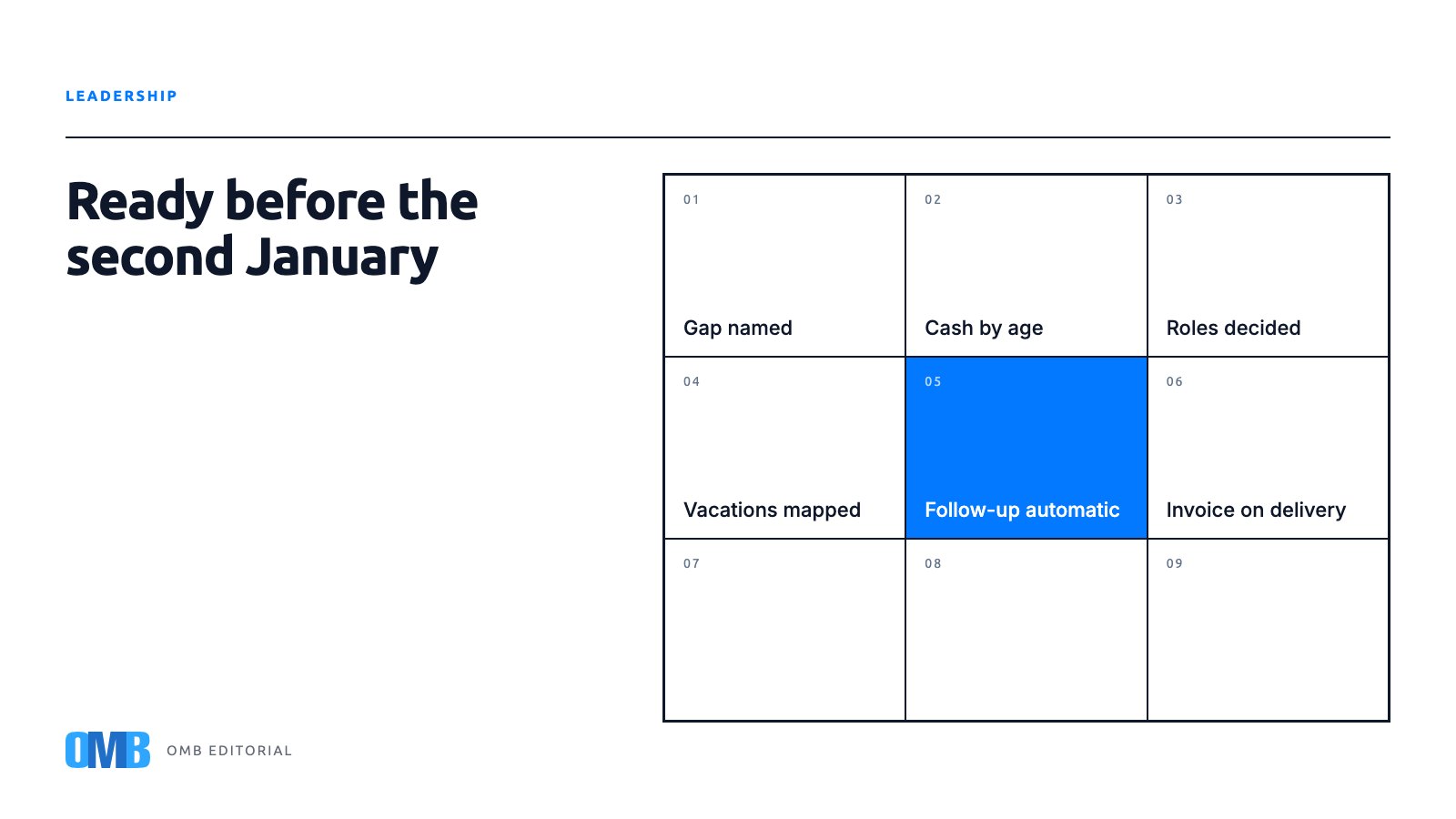
Before the Tuesday after Labor Day, a CEO should have the year-to-date gap named in one page, a first frame of the 2027 budget, receivables by age, every open role decided, the vacation calendar through December, one conversation with each direct report, and systems that follow up, answer inquiries and invoice without depending on anyone's memory. Three of the twelve matter most: the gap, the roles and the automatic follow-up.
In the United States the working year has two starts. One is January. The other is the Tuesday after Labor Day, when the out-of-office replies switch off, the school buses come back, and every calendar fills within a week. The second start is quieter and, for most companies, more decisive: it opens the sixteen weeks that decide whether the year ends where the plan said it would.
CEOs who use those weeks well tend to arrive at them with a short list already handled. What follows is that list, in three blocks: the numbers, the people and the machine.
The numbers you should not have to ask for
- Year-to-date against plan, in one page. Revenue, gross margin, cash and pipeline, each with the January number next to the August number. If assembling that page takes a week, the problem is not the page.
- The gap, named. If the plan said twelve million and August says eight, the remaining four is the number every September decision answers to. Write it down before anyone proposes a solution.
- The first frame of the 2027 budget. Not the final version, which lands in November, but the shape: which constraint gets funded, what gets cut, what stays flat. September conversations are cheaper when the frame already exists.
- Receivables by age. Know what is owed and for how long. Cash collected in September and October funds the fourth quarter; cash chased in December funds nothing.
The people who will carry the last third
- Every open role decided. Either the hire is approved with a start date before mid-October, or the role is closed for the year. A role that stays open through the fall is a role the current team is already covering, unpaid.
- Vacation calendar through December. Thanksgiving week and the last two weeks of December are effectively gone. Knowing who is out when turns a surprise in November into a plan in September.
- One conversation with each direct report. Thirty minutes each, before the calendar fills, on two questions: what will you finish by December, and what do you need from me to do it. The answers are the real operating plan.
- A name on every line of the gap. Shared ownership in September becomes nobody's ownership in November. One person per number, written where the team can see it.
The machine that runs while you are in meetings
- Follow-up that happens without you. Every proposal sent in September needs a follow-up in October whether or not anyone remembers. If that depends on memory, fix it before the volume arrives.
- Inquiries answered the same hour. The September push produces inquiries at a pace the spring did not. A lead that waits a day in September is a lead that talked to someone else, because everyone else came back too.
- Invoices issued on delivery. Not at month end. The difference between invoicing on the day and invoicing on the thirtieth is up to thirty days of cash, every month, for the rest of the year.
- One place where the week's status lives. A CEO who has to ask three people for the state of the pipeline, the receivables and the marketing spend will spend the fall asking. A single view, updated by the systems themselves, gives those hours back.
Twelve points is a lot to have ready by the first week of September, and most companies arrive with eight or nine. That is fine, provided the missing ones are chosen rather than forgotten. The ones to insist on are the gap named, the roles decided and the follow-up that runs on its own, because those three determine whether the other nine matter.
Notice that the list has no item about strategy. September is late for strategy and early for panic. It is the right month for execution with a clear number, a full team and systems that do the remembering. A company that arrives at Labor Day with those three will find the last third of the year shorter than it looks, in a good way.
One practical note on sequencing. The numbers block can be done in a single afternoon in the last week of August if the systems already hold the data, and in a very long week if they do not. The people block needs two weeks of calendar and cannot be compressed. The machine block is the one most CEOs skip, because it feels like an operations task rather than a leadership one, and it is the block that decides whether the other two hold up under September's volume. Do it first if you can only do one.
Key points
- Name the year-to-date gap in one line before anyone proposes a solution for it.
- Decide every open role before Labor Day: approved with a start date, or closed for the year.
- Hold one thirty-minute conversation with each direct report on what they will finish and what they need.
- Make follow-up, inquiry response and invoicing run on systems rather than on memory before the September volume arrives.
- If only three items get done, choose the gap, the roles and the automatic follow-up.
Frequently asked questions
Why is the week after Labor Day important for business planning?
In the United States most decision makers return from summer at the same time, so proposals, budgets and hiring all restart in the same week. That makes early September the effective start of the last third of the year. A CEO who arrives with the gap to plan named, roles decided and follow-up running on systems can use those weeks for execution rather than preparation.
What should a CEO review before the fourth quarter?
Four numbers in one page: revenue, gross margin, cash and pipeline, each against the January plan. Then receivables by age, because cash collected in the fall funds the quarter. Then people: open roles, the vacation calendar through December and one short conversation with each direct report. Finally, whether follow-up, inquiries and invoicing depend on memory or on systems.
How do you close a revenue gap in the last four months of the year?
Start by writing the gap as a single number and assigning a name to each part of it. Then touch every open proposal in the first week of September, reopen accounts that went quiet in summer, and make sure quotes, contracts and invoices can be issued the same day someone says yes. Speed and follow-up close more of the gap than discounts do.
Should you want a second opinion on which of the twelve are ready and which are not, a short diagnosis in the last week of August is a small investment against a sixteen-week season.
About the author
 Anna LaurentExecutive AssistantOMB Editorial Team
 Part of the OMB Cloud AES agent team, writing from what they see every day operating businesses.