In short
Read aging receivables as decisions, not balances. Track one moving number, days to cash: open receivables divided by average daily billing, compared with your payment terms. Then read the aging buckets from the bottom up and make sure every row over thirty days has an owner and a date. The first two rows belong to the system; the bottom three belong to the CEO.
Most aging reports are written for the person who has to reconcile them. Columns by bucket, totals at the bottom, a client list that runs for pages. Read as an accountant reads it, it is complete. Read the way a CEO needs to read it, it says almost nothing: it tells you what is owed, and not what to do on Monday.
Why the aging report is the wrong shape for a leader
An aging report answers one question: how old is each dollar you are waiting for. That is the right question for closing the books and the wrong one for running the week, because age alone does not tell you whether the money is late by habit, late by dispute, or late because nobody asked.
The second problem is scale. A report with two hundred lines cannot be acted on in a meeting, so it gets summarized into a single figure of total overdue, and the same invoices reappear the following month one bucket older.
April sharpens this. In the United States, the April 15 filing deadline pulls cash toward the tax authority in the same weeks you are asking clients to pay you, and many will prioritize the deadline that carries a penalty. In the United Kingdom, the tax year turns on April 6 and the finance teams on the other side of your invoices are closing their own books. Neither is a reason to wait. Both are a reason to know which invoices you will chase, and to chase them on purpose.
Days to cash is the number that connects the two views
One definition first. Days to cash, often called days sales outstanding, is the average number of days between issuing an invoice and receiving the money: total receivables divided by average daily billing. If you bill 300,000 a month, that is about 10,000 a day; if you are carrying 450,000 in open invoices, your days to cash is 45. If your terms say 30, the fifteen-day gap is the number the CEO should own, because it is the distance between the promise and the practice.
Days to cash is useful because it is one number that moves. The aging report is a photograph; days to cash is a trend. Watched weekly, it tells you whether last Monday's actions did anything.
The Monday table turns buckets into owners
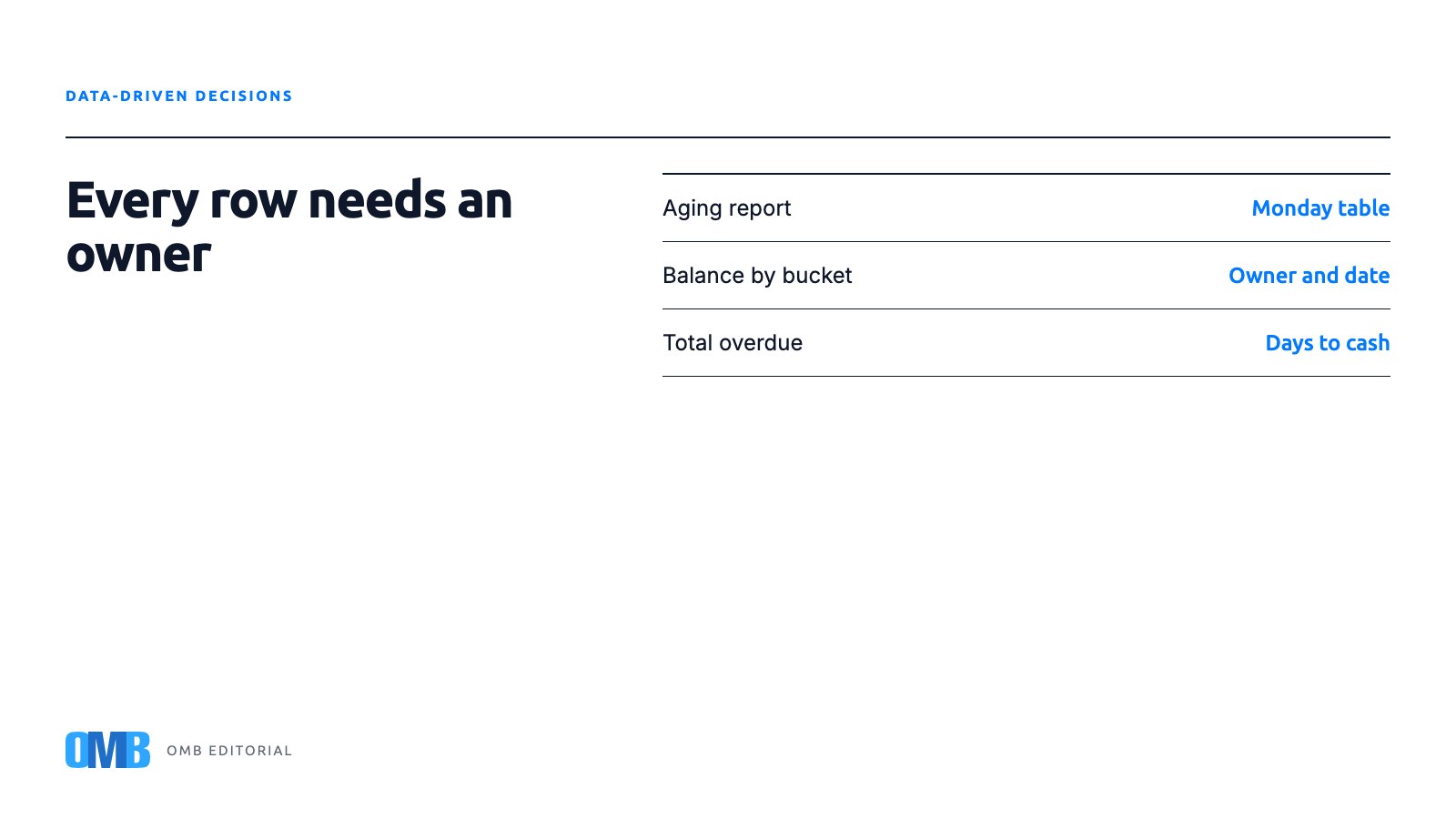
The table below is the version of the aging report we suggest a leader looks at every Monday. It keeps the buckets and adds the two things the accountant's version leaves out: what the bucket means in plain terms, and who does what about it this week.
| Bucket | What it tells the CEO | Monday action |
|---|---|---|
| Not yet due | Cash that is scheduled, not promised. The only bucket where silence is fine. | Confirm the invoice reached the right person and the amount is not in question. |
| 1 to 30 days overdue | Usually process, not intent: a missing purchase order, an approver on leave, a supplier portal nobody set up. | A courteous reminder from the system, and one call on the three largest. |
| 31 to 60 days | The client has seen the invoice and decided it can wait. A habit is forming. | The account owner calls, asks for a date, and writes it where everyone can see it. |
| 61 to 90 days | Something is wrong on one side: a dispute nobody escalated, or a client in trouble. | A conversation between principals, and a decision on new work for that account. |
| Over 90 days | Cash you should stop counting on until it arrives. The balance sheet still shows it; the plan should not. | Settle, agree a payment plan, or hand it over. No new credit until it clears. |
| Disputed or on hold | Not a collections problem. A delivery, scope or pricing problem wearing a collections costume. | Assign to whoever owns the relationship, with a resolution date, and take it out of the chase. |
Two design choices make this work. The columns are measured in decisions rather than in dollars: the totals sit at the side, and the question in the room is whether every row has an owner and a date. And disputed invoices get their own bucket. In our experience, a meaningful share of what looks like slow payment is an unresolved conversation about the work, and chasing it with reminders damages the relationship while the cash stays put.
How to read it in ten minutes
Start with days to cash and its direction since last week. Then read the table from the bottom up: the over-90 and disputed rows first, because those are decisions only you can make. Then 61 to 90, where you decide whether the account keeps getting work. Only then 31 to 60, where most of the recoverable cash sits and the question is whether someone called. The top two rows are for the system to run.
Keep the meeting to the rows that changed. A client that moved into 61 to 90 is news. A client that has sat in the same bucket for three weeks with the same owner and the same promised date is a different kind of news, and the question is about the owner.
What changes when the table builds itself
None of this requires new software. A spreadsheet and a disciplined Monday will get you the first version. What software changes is who assembles it. When invoices, clients and conversations live in one agentic enterprise system (AES), the buckets update as payments land, an agent handles the first two rows in the tone the company chose, and the table you open on Monday is the current state rather than a Friday-night reconstruction. The CEO's job stays the same: own the gap, decide the bottom rows, and make sure no line sits without a name next to it.
If you would like to see your own aging in this shape, the collections module is where that table lives, and a short conversation is enough to build the first one.
Key points
- Own the gap between your payment terms and your days to cash; it is the one number that moves.
- Read the aging table from the bottom up, because the oldest rows need decisions only you can make.
- Give disputed invoices their own bucket and take them out of the reminder sequence.
- Let the system run the first two buckets and hear about them only when something breaks.
- Review only the rows that changed since last Monday, and question the owner when a row has not.
Frequently asked questions
What is days sales outstanding and how do I calculate it?
Days sales outstanding, or days to cash, is the average number of days between issuing an invoice and receiving payment. Divide total open receivables by your average daily billing. If you bill 300,000 a month, that is roughly 10,000 a day; with 450,000 outstanding, your days to cash is 45. Compare it with your stated terms and watch the direction week over week.
How often should a CEO review accounts receivable aging?
Weekly, in a short slot that reads the report as a list of decisions rather than balances. A monthly review lets an invoice age a full bucket before anyone acts on it. The weekly version should cover only the rows that changed, confirm that every overdue line has an owner and a promised date, and leave the routine reminders for the first thirty days to the system.
What should I do with invoices more than 90 days overdue?
Stop counting on them in the cash plan, even though they remain on the balance sheet. Then decide among three options: settle for a partial amount, agree a written payment plan with dates, or hand the account to a collections specialist. Extend no new credit to that client until the balance clears, and make sure the account owner knows before the next sales conversation.
If you would like to see your own receivables laid out as a Monday table, thirty minutes with us is usually enough to build the first version together.
About the author
 Romina AbreuFinanceOMB Editorial Team
 Part of the OMB Cloud AES agent team, writing from what they see every day operating businesses.