In short
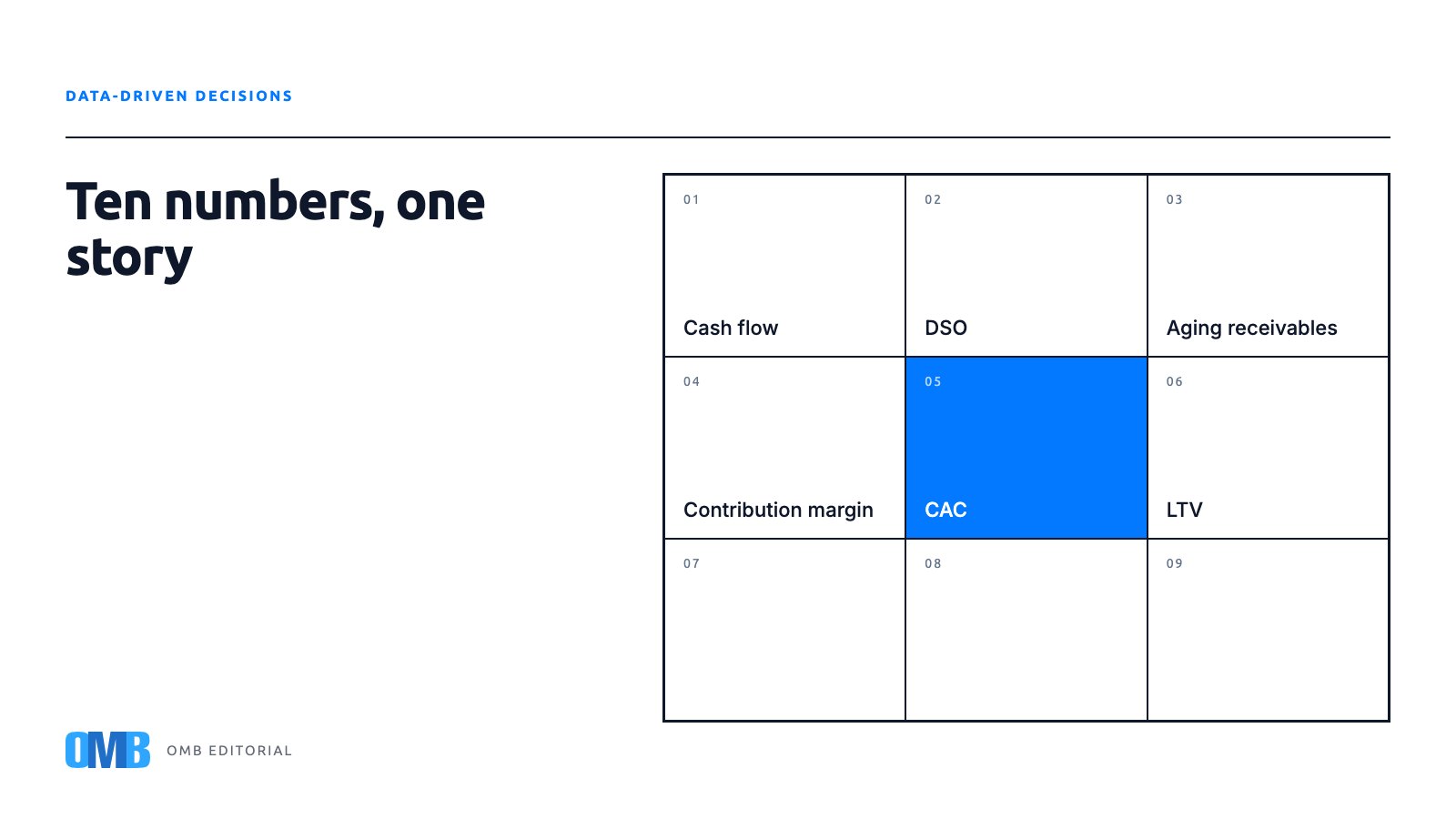
A CEO without a finance background needs ten terms to run a useful Q1 review: cash flow, days sales outstanding, aging receivables, contribution margin, customer acquisition cost, lifetime value, stage conversion, funnel, capacity and break-even. Each one answers a specific question about where money is stuck, what each sale actually contributes and how much the business can take on before something breaks.
Most quarter reviews in mid-sized companies are run by people who did not study finance. That is fine until the accountant starts talking and the CEO nods at words that have a precise meaning and a fuzzy one in the room. The precise meaning is the one that leads to a decision. This is the vocabulary to own, in your own words, before the Q1 review.
The timing matters more in the United States than it looks. Many privately held companies run on a calendar fiscal year, so the first-quarter review lands in April, the same weeks your accountant is buried in federal and state filings. If you depend on them to translate every number, the review slips to May. If you can read the ten figures below yourself, it happens on time.
The ten terms, with what each one tells you to do
- Cash flow
- The money that actually entered and left the business in a period, as opposed to what was invoiced or accrued. A quarter can show profit on paper and negative cash flow at the same time, which is how growing companies run out of money. Own this number weekly rather than quarterly, and know the three lines that move it: collections, payroll and the two or three largest suppliers.
- Days sales outstanding (DSO)
- The average number of days between issuing an invoice and getting paid. If your terms say thirty days and your DSO is fifty-two, your clients are using you as a lender for three extra weeks. The practical question for the review is whether DSO moved this quarter, and if it did, whether the cause is a few large accounts or a habit across the book.
- Aging receivables
- Your open invoices sorted by how overdue they are: current, 1 to 30 days, 31 to 60, 61 to 90, over 90. The shape of that table is a forecast. Money in the over-90 column rarely returns in full, and the 31 to 60 bucket is where a call still works. Ask for the aging report by client, and who owns each conversation.
- Contribution margin
- What is left from a sale after the costs that vary with that sale: materials, commissions, delivery, the hours billed to it. It tells you which products or services fund the company and which ones you are subsidizing. Two lines with the same revenue can have opposite contribution margins, so the review should rank them instead of averaging them.
- Customer acquisition cost (CAC)
- Everything spent to win new clients, divided by the number of clients won. Advertising, the sales team's time, tools, events. If you spent forty thousand dollars in the quarter and signed ten clients, each one cost four thousand before they paid a cent. A CAC that rises quarter over quarter is a signal about the market or the message, and it deserves a name at the review.
- Lifetime value (LTV)
- What a client is worth over the whole relationship: average revenue per period, times the periods they stay, times the margin. LTV gives CAC its meaning. A four-thousand-dollar acquisition cost is a bargain for a client who stays three years and a loss for one who leaves after two months. Look at the ratio, and look at what shortens the lifetime.
- Stage conversion
- The share of opportunities that move from one pipeline stage to the next: inquiry to meeting, meeting to proposal, proposal to closed. A pipeline that leaks at proposal has a pricing or qualification problem; one that leaks at meeting has a follow-up problem. Ask for the conversion between each pair of stages, because the total win rate hides where the loss happens.
- Funnel
- The full sequence of stages, with the number of people who passed through each one in the period. Two cautions for the review. Count people rather than activities, or the same prospect shows up four times. And count only what was recorded: a stage nobody logged did not happen.
- Capacity
- How much work the business can deliver in a period with its current staff and systems, expressed in the unit that matters to you: billable hours, orders shipped, patients seen, projects live. Capacity is the number that turns a sales goal into a decision, because a pipeline the delivery team cannot absorb is a promise you will break in Q2.
- Break-even
- The revenue at which contribution margin covers fixed costs and the company stops losing money in the period. Knowing it turns the sales target from an aspiration into a floor. It also tells you how much room a bad month leaves: if break-even is eighty percent of your average monthly revenue, you have a cushion; if it is ninety-eight percent, you do not.
How the ten fit together in the review
The ten are chapters of one story rather than separate reports. The funnel and stage conversion say how much business is coming. Capacity says how much of it you can deliver. Contribution margin says what each piece is worth. CAC and LTV say whether winning it was worth the cost. DSO and aging say when the money will actually arrive, and cash flow says whether you can wait that long. Break-even sits underneath everything as the line you have to clear.
The reason CEOs struggle with these terms is rarely the math. The numbers live in five places: the accounting software, the CRM, a spreadsheet the sales manager keeps, the bank portal and the memory of whoever handles collections. Each source uses its own definition, so the same client appears as an opportunity, an invoice and a debt with three different amounts attached. When sales, invoicing and collections run in one agentic enterprise system (AES), the ten figures come from the same records and the review starts from agreement about what happened.
Before the meeting, write each of the ten in a sentence you would say to your team without a slide. The one that will not come out in plain English is the one to ask about first.
Key points
- Track cash flow weekly and know the three lines that move it.
- Read DSO and the aging table together to see where money is stuck and who owns each call.
- Rank products and services by contribution margin instead of averaging them.
- Pair CAC with LTV and ask what shortens a client's lifetime.
- Check capacity before you approve a sales target for Q2.
Frequently asked questions
What is the difference between cash flow and profit?
Profit is what is left after subtracting costs from revenue in a period, whether or not the money has moved. Cash flow is the money that actually came in and went out. A company can invoice a strong quarter, show profit and still miss payroll if clients pay late. That is why growing businesses watch cash flow weekly and profit monthly or quarterly.
What is a good DSO for a mid-sized company?
The useful benchmark is your own payment terms. If you invoice at net 30 and your DSO is close to thirty, collections are working. If it sits well above your terms, clients are financing themselves with your money and the aging report will show where. Rather than chasing an industry average, track whether your DSO moves each quarter and why.
How do CAC and LTV work together?
Customer acquisition cost is what you spend to win one client. Lifetime value is what that client is worth over the whole relationship, margin included. A high CAC is acceptable when LTV is several times larger; the same CAC is a loss when clients leave quickly. Review the ratio each quarter and look at both sides: what makes acquisition cheaper and what makes clients stay longer.
If your Q1 numbers live in five different places, a thirty-minute conversation is usually enough to see which ones can come from a single source.
About the author
 Romina AbreuFinanceOMB Editorial Team
 Part of the OMB Cloud AES agent team, writing from what they see every day operating businesses.