In short
With sales, collections and marketing in separate tools, the quarter close is a reconstruction: someone assembles the report, the meeting argues about whose number is right, leads wait for follow-up and unpaid invoices sit unnoticed. When the three live in one system, the report exists before anyone asks, the meeting decides, follow-up runs on its own and every overdue invoice has an owner.
Every industry closes the quarter differently, and every industry closes it the same way. A specialty distributor counts orders and open invoices; a professional services firm counts billable hours and proposals out; a clinic group counts appointments and no-shows; a manufacturer counts shipments and what is still on the floor. Underneath, the ritual is identical: someone has to assemble what happened from tools that do not agree with each other, and the leadership team meets to argue about the result.
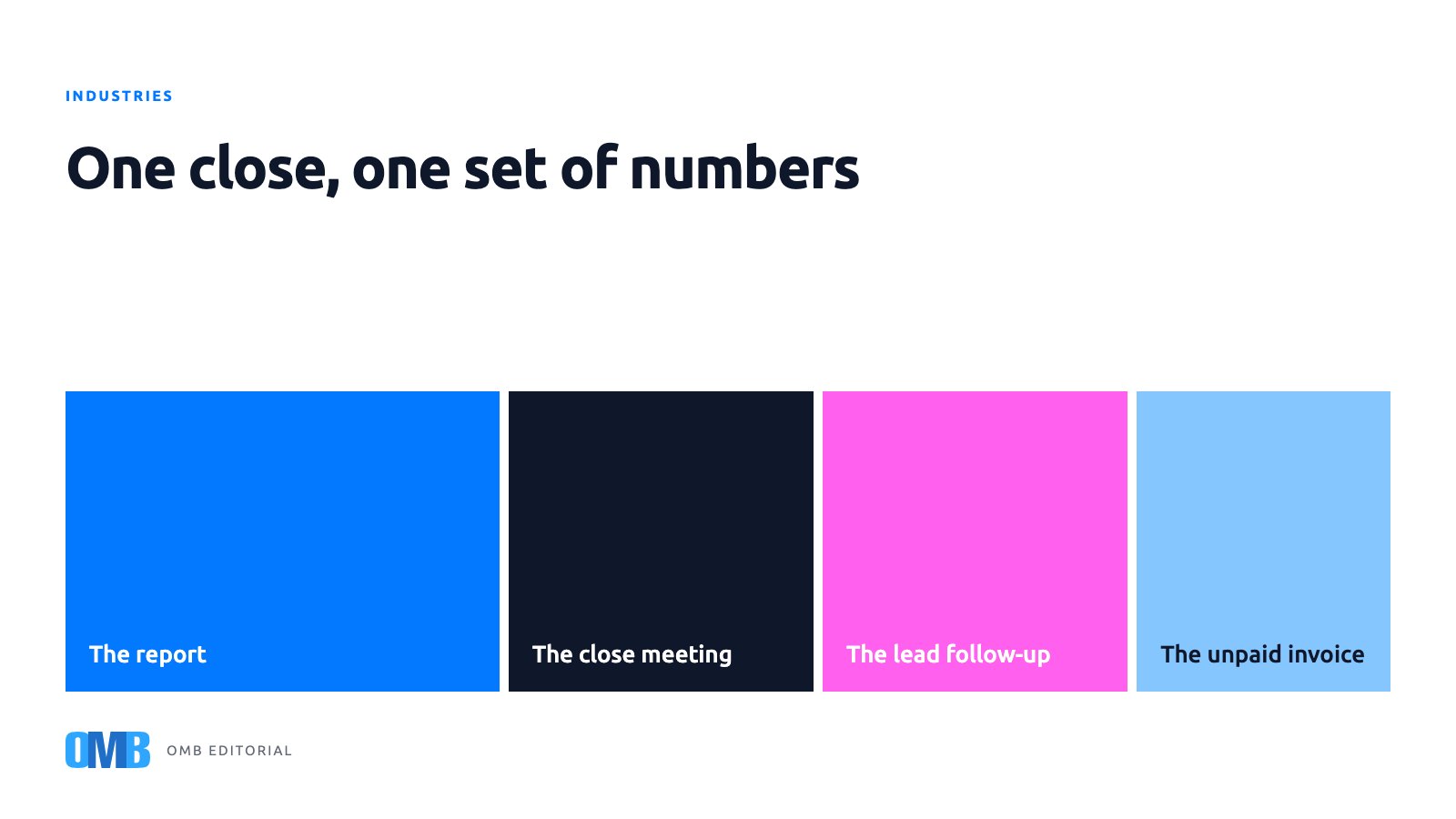
The four moments below are the ones we see repeated across those industries. Each is told twice: first with sales, collections and marketing living in separate tools, then with the three running in one agentic enterprise system (AES). No figures, because the numbers are yours. What changes is who does the work and when.
The same four moments, with and without one system
Before
The report. Two days before the close meeting, an operations manager opens the CRM export, the accounting export and the ad platform's dashboard, and starts matching them in a spreadsheet. Clients are spelled three ways. A deal marked won in the CRM has no invoice yet; an invoice exists for a deal the CRM still shows as a proposal. The marketing column comes from a different date range than the sales column. The report is finished at eleven at night and everyone in the room knows it contains at least one number that is wrong.
The close meeting. The first forty minutes go to reconciling. Sales says the quarter closed at one figure, finance has a lower one, marketing shows leads that sales never saw. By the time the room agrees on what happened, there is no time left for what to do about it. Decisions are postponed to a follow-up meeting that inherits the same problem.
The lead follow-up. The last two weeks of the quarter brought a spike of inquiries from the campaign, and the reps were busy closing. The inquiries sit in the marketing tool's inbox, tagged and unread. When someone gets to them in the second week of the new quarter, half have gone quiet, and no one can say which ones deserved a call because the campaign data and the conversation history live apart.
The unpaid invoice. An invoice from January is sixty days overdue. Finance knows; sales does not. The account manager calls the client to talk about a renewal on the same afternoon that a reminder from accounting lands in the client's inbox. The client points out the contradiction. The renewal conversation becomes a complaint about being chased.
After
The report. There is no assembly, because the quote that was accepted became the invoice, the invoice carries the client that came from the campaign, and the campaign is tied to the conversation the agent had with that client on day one. The report is a view of the same records, filtered by the quarter, and it existed on the first day of the period as a live page rather than on the last day as a file. Anyone can open a figure and see the rows behind it.
The close meeting. The room starts from agreement about what happened, because the numbers come from one place and each one can be opened. The forty minutes go to the questions that matter: why proposals stalled in one segment, whether the collections issue is two clients or a pattern, which campaign produced clients who actually paid. The meeting ends with decisions and owners, in the same session.
The lead follow-up. The quarter-end spike of inquiries was answered within minutes by the agent, qualified against the profile the business defined, and the promising ones landed in the reps' pipeline with a summary of what each person asked. Nothing waited for a human to have a free morning. When the reps came up for air, they found conversations already in progress rather than a backlog to apologize for.
The unpaid invoice. The January invoice moved into the overdue stage on its own at day thirty-one, with a soft reminder sent in the company's tone. At day sixty it appeared on the account manager's screen next to the renewal opportunity, so the renewal call opened with the invoice, handled with care, before the renewal was discussed. The client received one coherent conversation instead of two contradictory ones.
What the contrast does not fix by itself
One system does not make a weak quarter strong. If the pipeline was thin in February, the report will say so sooner and more clearly, and that is the whole benefit: the close stops being a forensic exercise and becomes a reading of the quarter as it actually went.
It also asks something of the business. Stages have to mean the same thing to everyone. A client has to exist once, with one name. Someone has to own the collections tone, and someone has to decide which inquiries deserve a rep. Those decisions were always necessary; separate tools simply let each department make them privately and discover the differences at the close.
Industries differ in what they count, and in our experience the pattern of the four moments barely changes from a distributor to a clinic to a design studio. What changes is how many people spend the last week of March rebuilding what the system already knew. If you would like to see which of the four moments costs you the most right now, a walk through the modules or a short diagnosis is where we usually start.
Key points
- Make the report a live view of the same records rather than a file assembled at the end.
- Move reconciliation out of the close meeting so the hour goes to decisions and owners.
- Let an agent answer and qualify quarter-end inquiries so reps find conversations instead of backlogs.
- Put the overdue invoice on the account manager's screen next to the renewal.
- Agree on stage definitions and a single client record before connecting anything.
Frequently asked questions
Why does the quarter close take so long in a mid-sized company?
Because the close is usually a reconstruction. Sales, collections and marketing each keep their own records with their own definitions, so someone has to export, match and correct them before the leadership meeting. The meeting then spends its time agreeing on the numbers. When the three functions share one set of records, the report already exists and the close becomes a review of what happened.
What should a quarter close meeting cover?
Decisions. Which segment's proposals stalled and what changes, whether overdue invoices are a few accounts or a pattern, which campaigns produced clients who paid, and what capacity the next quarter needs. If the meeting is spent reconciling figures, the reconciliation should move out of the room and into the systems, so the hour goes to what the leadership team is actually there for.
How do connected sales and collections systems prevent client complaints?
When the account manager and the collections process read the same record, the client hears one coherent message. The overdue invoice appears next to the renewal opportunity, so the renewal call handles it first and with care, and the automated reminder does not land on the same afternoon as a sales call. Contradictions between departments are what clients experience as being chased.
If the last week of March still means rebuilding what your systems already knew, thirty minutes with us is usually enough to see which of the four moments to fix first.
About the author
 Tatiana MendesMarketingOMB Editorial Team
 Part of the OMB Cloud AES agent team, writing from what they see every day operating businesses.