In short
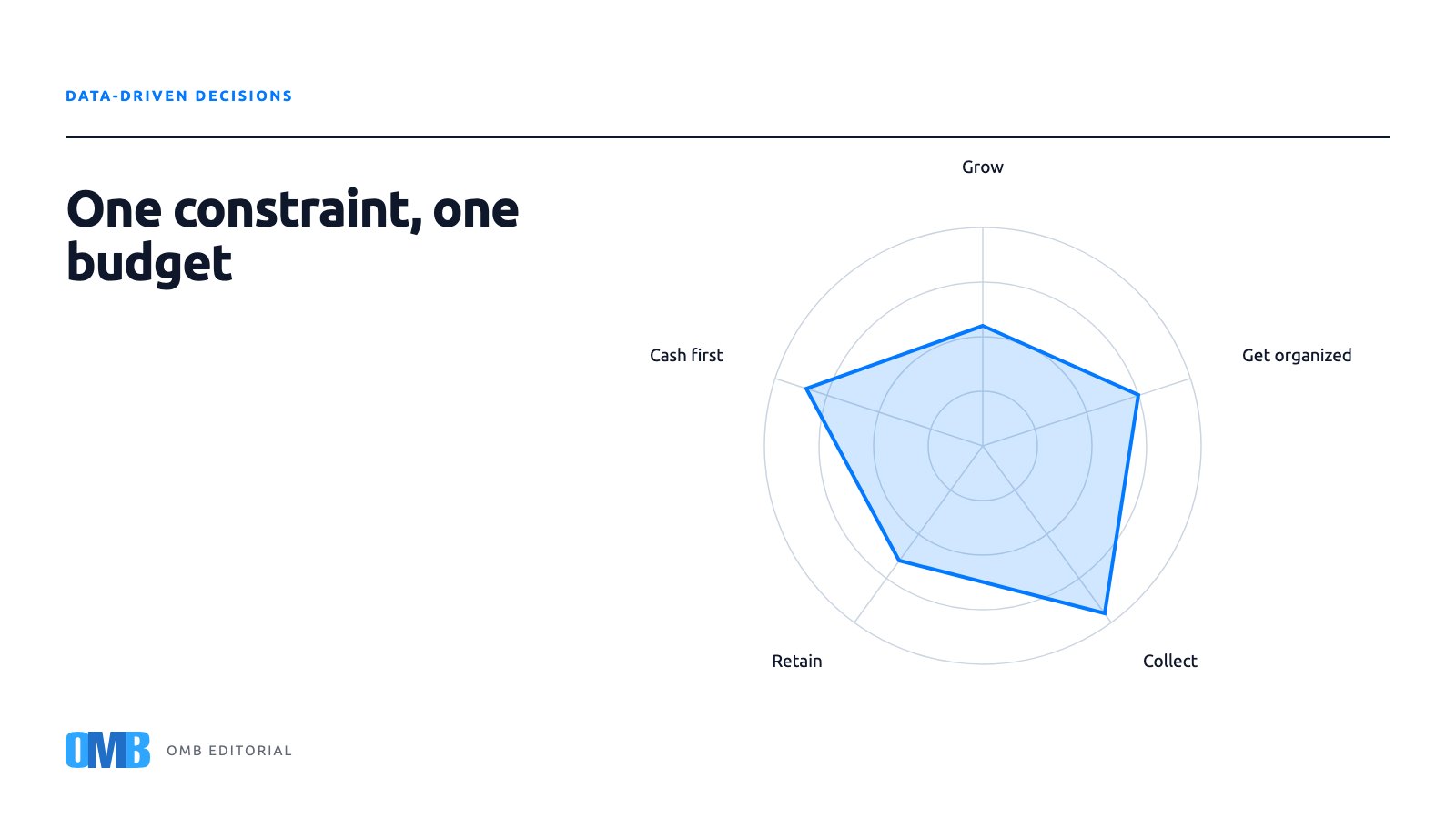
Put the 2027 digital budget behind the one constraint that costs the most today. If demand is short, fund acquisition and response. If the team is drowning, fund one system of record. If cash arrives late, fund invoicing and collection. If customers drift, fund follow-up and retention. Pick one, attach a number and a date, and let the other lines wait a quarter.
Every August a version of the same spreadsheet opens on a finance director's screen. Column A lists the tools the company pays for. Column B lists what each one costs. Column C is blank, and it is supposed to say what each one is for. The 2027 budget conversation usually starts by trying to fill column C, which is the wrong place to start.
Start with the situation the business is in. A company that needs to grow spends differently from one that needs to get organized, and both spend differently from one that is owed money it has not collected. The tools follow from that. Budgeting the other way around, tool by tool, produces a list of renewals and a vague hope that the total adds up to progress.
Four questions that place your company on the tree
Before you reach the branches, answer four questions with numbers you can defend. First, is demand the constraint or is delivery? If sales could close twice as many deals and the company could deliver them, demand is the constraint. If the pipeline is full and projects slip, delivery is. Second, how many days pass between an invoice being issued and being paid, on average? Third, what share of last year's revenue came from customers who also bought the year before? Fourth, how much time does the team spend moving information between systems by hand? If you cannot answer one of them, that gap is itself a budget line.
One more rule before the branches: the budget follows one situation at a time. Companies that try to fund all four at once end up with a little of everything and a finished version of nothing. Pick the constraint that costs the most today, fund it properly, and let the others wait one quarter.
If demand is the constraint and delivery has room
Then the budget goes to generating and qualifying opportunities: paid acquisition with tracking that reaches the CRM, outbound capacity, and an agent or a person who answers every inquiry within minutes. Measure it in first conversations per week, then in proposals sent. A company that adds ten qualified conversations a week and closes one in five has added two customers a week before a single new hire.
If the pipeline is full and the team is drowning
Then growth spend is wasted until the company gets organized. Fund one system of record, migrate the spreadsheets into it, and pay for the time to do the migration properly rather than for another tool. Getting organized shows up as fewer hours spent looking for things and fewer promises missed. If your team spends an hour a day reconciling data across systems, that is five hours a week per person, and the budget to remove that pays for itself in headcount you do not need to add.
If invoices go out but cash comes in late
Then the budget goes to collection: invoicing issued the day the work is delivered, reminders that go out on a schedule without anyone remembering to send them, and a clear view of who owes what by age. Moving average days to pay from sixty to forty-five at a company billing two hundred thousand dollars a month frees roughly a hundred thousand dollars of working capital without selling anything new. That is often the highest-return line in the whole budget.
If new customers arrive but old ones drift away
Then retention is the situation, and it is the one most often underfunded because it feels like it should be free. Budget for a follow-up cadence after every delivery, a way to see which accounts have gone quiet, and a person or an agent whose job is to reopen those conversations. If a third of your revenue comes from repeat buyers, protecting that third is cheaper than replacing it.
If two constraints are tied
Then fund the one closer to cash. Collection beats growth, because collected cash funds growth next quarter. Organization beats retention, because an organized company retains by default. Write the second constraint into the budget for the second quarter of 2027 with a number attached, so it becomes a decision deferred rather than a decision avoided.
What the tree does not tell you
The branches sort the money. They do not tell you how much. In our experience a reasonable digital budget for a mid-sized company is whatever removes the constraint within two quarters, and no more. If a line cannot show a result by June 2027, it belongs in the second-half review, not in January's commitment.
They also do not account for what you already pay for. Before adding a line, list the current subscriptions and ask which of them serve the chosen situation. A company that picks collection as its 2027 priority and still pays for three marketing tools it barely opens has found its first savings without cutting anything that matters.
And the tree assumes the constraint stays put. It will not. A company that fixes collection in the first quarter often discovers that demand was the next constraint all along. That is the point of budgeting by situation: the money moves when the situation moves, and column C finally has something honest in it.
If the systems that generate, organize, collect and retain live in one place, moving budget between them is a setting rather than a migration. That is worth knowing before you commit to a separate tool for each branch. Whichever branch you are on, write down the number you expect it to move and the date by which you expect to see it. A budget with a number and a date is a decision. Everything else is a wish list with a total at the bottom.
Key points
- Answer four questions with real numbers before touching the budget: demand or delivery, days to pay, share of repeat revenue, hours lost to manual data.
- Fund one constraint at a time and write the second one into the second quarter of 2027 with a number attached.
- When two constraints tie, fund the one closer to cash, because collected cash pays for growth next quarter.
- Review current subscriptions against the chosen constraint before adding a single new line.
- Give every budget line a number it must move and a date by which it must move it.
Frequently asked questions
How should a mid-sized company decide its digital budget for 2027?
Start from the constraint that costs the most today rather than from the list of tools. Decide whether the company needs to grow, get organized, collect faster or retain customers, and fund that one situation properly for two quarters. Then attach a number and a date to the line so the budget can be checked in June and moved if the constraint has changed.
What share of the digital budget should go to sales versus operations?
There is no fixed ratio that works across companies. The useful split is by constraint: if demand is short, most of the budget goes to acquisition and response; if delivery is the bottleneck, it goes to a system of record and the time to migrate into it. A company with late payments often earns more from collection tooling than from any marketing line.
Is it better to buy one platform or several specialized tools?
Several tools are cheaper to start and more expensive to run, because someone has to move information between them by hand. If your team spends an hour a day reconciling systems, that cost belongs in the comparison. A single system where sales, invoicing and follow-up share the same records lets you move budget between priorities without a migration each time.
If you would like a second opinion on which constraint your 2027 budget should fund, a thirty-minute conversation with your current numbers is enough to see it.
About the author
 Romina AbreuFinanceOMB Editorial Team
 Part of the OMB Cloud AES agent team, writing from what they see every day operating businesses.