In short
Before an automated collections sequence sends its first reminder, the system must have verified due dates, the right paying contact, disputed invoices paused, and payments matched daily. Every message must be written and approved by a person, ask before it accuses, vary from step to step, and accept replies that pause the sequence. Each account needs a named owner, and every touch must be logged against the invoice.
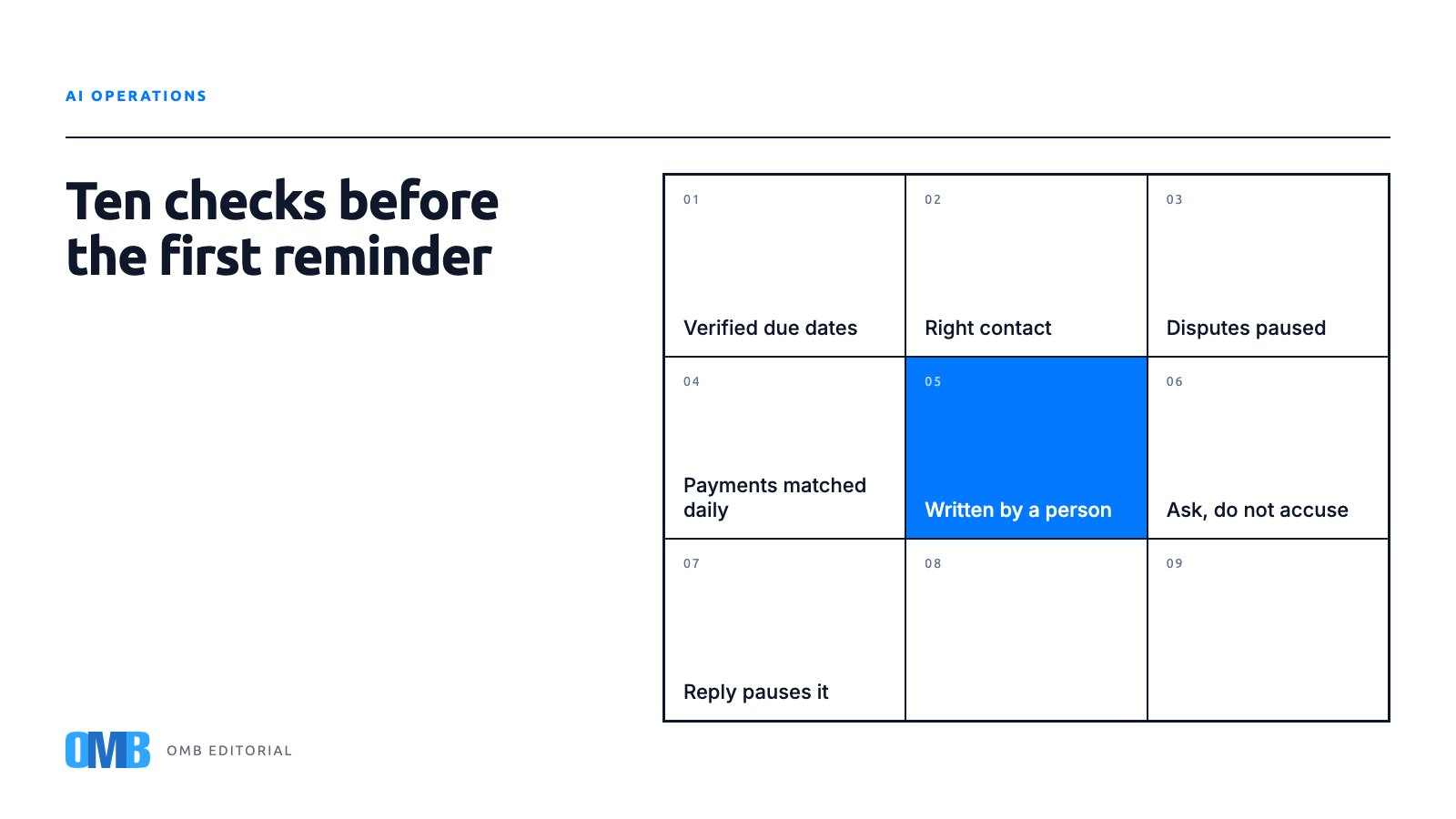
The first automated reminder decides how every later one is received. If it lands on the wrong person, quotes the wrong amount, or reads like it was written by a machine that has never met your client, you have taught them to ignore the sequence. If it reads like a courteous note from someone who knows the account, it does most of the work of collections on its own. The difference is rarely the software. It is the ten checks below, and whether they were done before anything was switched on.
Before the system is allowed to trust the data
- Every invoice has a verified due date. Not the date it was sent plus thirty, but the date the contract says, after any client-specific terms. One wrong due date produces a reminder the client can prove is early, and that is the end of their trust in the rest.
- The contact is the person who pays, not the person who bought. Accounts payable and the sponsor who signed are often different people. The sequence needs both names, and it needs to know which one gets the first note and which one gets the escalation.
- Disputed and on-hold invoices are out of the queue. An invoice with an open question about scope or delivery is not late; it is unresolved. The system must be able to pause it with one click and route it to the account lead with a date, so a reminder never lands on top of a complaint.
- Payments are matched daily. A reminder for an invoice paid three days ago is the fastest way to look careless. Bank feeds, payment links and remittance emails must update the record before the sequence runs, or the sequence should not run.
Before the tone is signed off
- A person wrote and approved every message. The templates are drafted in the company's voice by someone who knows the clients, approved by whoever owns the relationship, and read aloud once. If a sentence would embarrass you in a meeting, it does not go in the template.
- The first note asks; it does not accuse. The purpose of the first reminder is to confirm the invoice reached the right person and that nothing is in question. "Did this reach you" collects more cash than "this is overdue," and it costs nothing in tone.
- Each step reads differently from the last. Three identical messages a week apart read as a machine. A courtesy note, then a short message with the invoice attached, then a personal line from the account lead, read as a company that is paying attention.
- The client can answer, and someone reads it. Every message has a reply path, and every reply pauses the sequence and lands with a person. An automated reminder that cannot be answered is a notice, not a conversation.
Before the human steps back
- Every account has a named owner and an escalation point. The system sends the first two touches; a person makes the third. The rule says who that person is for every account, and when their step is due, before the sequence starts.
- Every touch is logged against the invoice. Anyone in the company can open the invoice and see what was sent, when, to whom, and what came back. Without that history, the account lead calls without context and the client hears two companies.
Two more things are not on the list because they are habits rather than checks. The first is to review the sequence every quarter against the replies it received: the messages that produced "sorry, sending now" stay, and the ones that produced silence get rewritten. The second is to keep a few accounts out of automation on purpose, the ones where the relationship is worth a call every time, and to say so in the record so nobody switches them on by accident.
There is a question behind all ten, and it is worth asking out loud before the first reminder goes out: would the person who currently chases this client be comfortable if every one of these messages went out under her name while she was on holiday? If the answer is yes, the setup is done. If it is "yes, except for that one client," you have found the account that stays manual.
In an agentic enterprise system (AES), these checks are what the collections agent is configured against: verified terms, the right contact, a pause for disputes, a tone written by a person, a human step at a fixed point, and a log that everyone reads. The agent does not replace that setup; it is what makes the setup run every day without someone having to remember. If you would like to walk through the ten checks against your own invoices, the collections module is where that conversation usually starts.
Key points
- Verify due dates and the paying contact before any reminder is allowed to go out.
- Pause disputed invoices with one click and route them to the account lead with a date.
- Have a person write, approve and read aloud every message in the sequence.
- Make the first note a question about receipt, and let every reply pause the sequence.
- Log every touch on the invoice so the account lead never calls without context.
Frequently asked questions
How do you automate payment reminders without sounding like a robot?
Have a person who knows the clients write each message once, in the company's own voice, and vary the messages from step to step so they do not read as copies. Make the first note a question about whether the invoice arrived rather than a statement that it is overdue. Give every message a reply path, and pause the sequence the moment a client answers, so a human picks up the thread.
When should the first payment reminder be sent?
Shortly before the due date, as a courtesy note confirming the invoice reached the right person and that nothing is in question. That single message catches missing purchase orders, wrong contacts and portal problems while there is still time to fix them. The first message after the due date should follow within a few days, with the invoice attached and an easy way for the client to say it is in process.
Should disputed invoices receive automated reminders?
No. An invoice with an open question about scope, delivery or pricing is unresolved rather than late, and a reminder on top of a complaint damages the relationship without moving the cash. The system should let anyone pause the invoice with one click, route it to the account lead with a resolution date, and resume the sequence only once the question is closed and the client agrees on the amount.
If you would like to run the ten checks against your own invoices before switching anything on, thirty minutes with us is usually enough to see where you stand.
About the author
 Mike SilvaTechnical SupportOMB Editorial Team
 Part of the OMB Cloud AES agent team, writing from what they see every day operating businesses.