In short
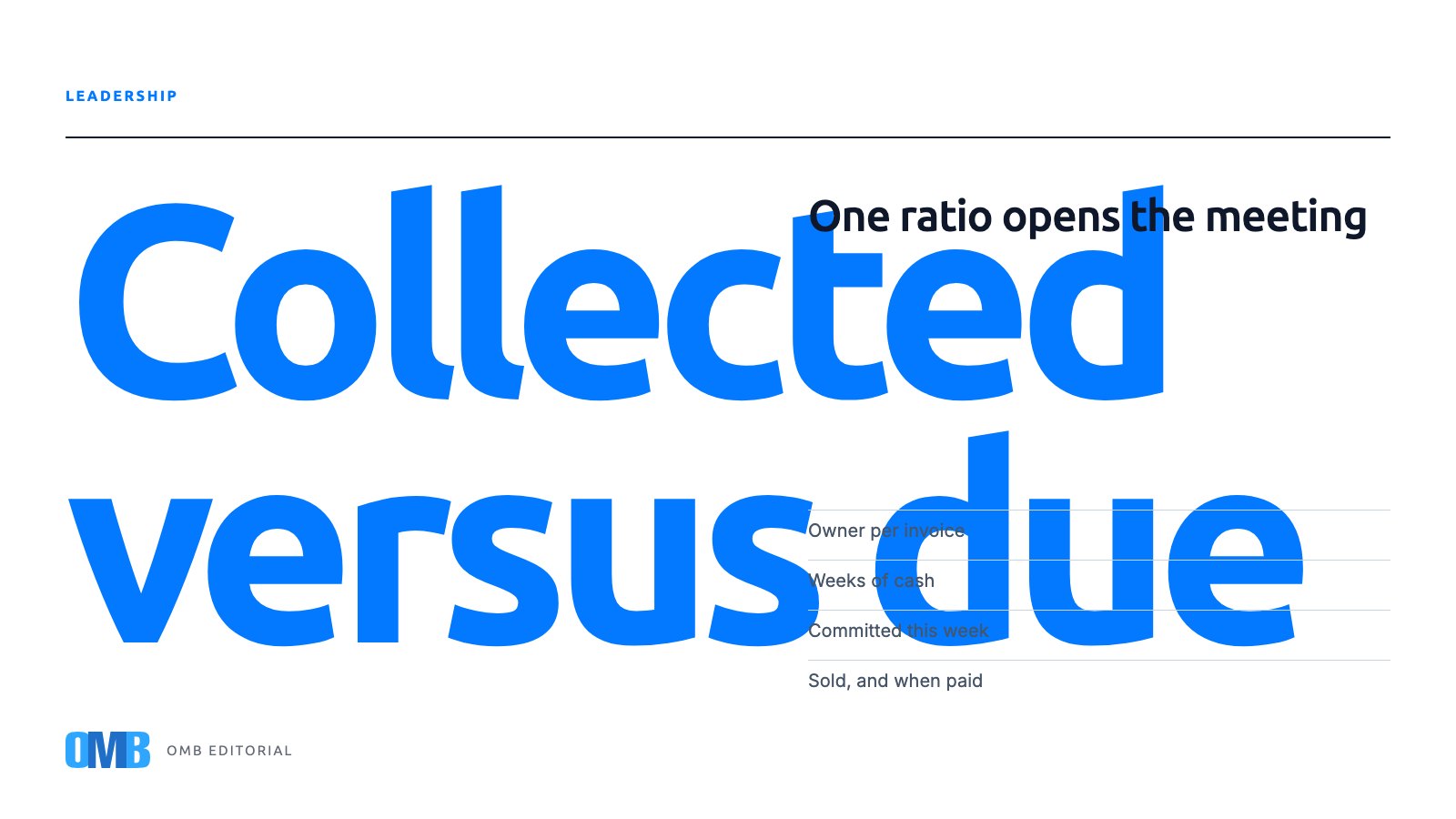
Open the Monday finance meeting with one ratio: cash collected last week divided by cash that was due last week. Then ask which invoices explain the gap and who is calling them, how many weeks of cash remain at the current outflow, what is committed to be paid this week, what last week's sales turn into cash and when, and what will be different by next Monday.
Monday morning is when the week still belongs to you. By Tuesday it belongs to whatever came in over the weekend. That is why the finance conversation deserves the first slot, and why it deserves a script. The questions below are the ones we suggest a CEO asks every week, in this order, with the answers on one page. None of them needs a finance background. All of them need a finance team that was told, in advance, that these are the questions.
What is the one number that should open the meeting?
Cash collected last week against cash that was due last week. Not revenue, not bookings, not the bank balance on its own. If 200,000 was scheduled to arrive and 140,000 did, the number is 70 percent, and the meeting starts from the 60,000 that did not come. The ratio matters more than the amount because it separates a quiet week from a week in which clients decided to wait.
The reason to open with it is that every other number in the meeting explains this one. Sales explains what will be due next month; the pipeline explains the month after that; the expense line explains what the cash has to cover. Open anywhere else and the room spends twenty minutes on context before it reaches the point.
April makes this discipline easier to justify. Tax payments leave company accounts in many markets this month, on both sides of your invoices, and a client who is short of cash mid-month will pay whoever asked most clearly. A weekly ratio tells you on the first Monday of the month whether that is happening to you.
Which invoices explain the gap, and who is calling them?
A gap of 60,000 is not something you can act on. Four invoices from three clients, each with a name next to it, is. Ask finance to bring the gap as a list, sorted by amount, with a column for the last contact and a column for the person who owns the next one. If the owner column is empty, that is the finding of the meeting, and it is fixable before lunch.
Resist the urge to discuss every line. The purpose is to make sure the large ones have an owner and a date, and to catch the ones that are not collections problems at all: a disputed deliverable, a purchase order that was never raised, a contact who left the client. Those go to the account lead, not to the reminder sequence.
How many weeks of cash do we have if nothing changes?
Take the cash in the bank this morning and divide by the average weekly outflow. If the account holds 600,000 and the business spends 100,000 a week, the answer is six weeks. Whether six is good or bad depends on your business; what matters on Monday is whether the figure moved since last week and in which direction.
Ask for it as weeks rather than as a balance, because weeks are comparable across months and balances are not. A payroll week and a quiet week can show the same bank figure with very different meanings. Ask also what large items sit inside the next four weeks: a tax payment, a quarterly rent, an annual subscription that renews. Surprises in cash are rarely surprises to the person who pays the bills; they are surprises to the person who did not ask.
What did we commit to pay this week, and can we?
The outflow side deserves the same honesty as the inflow side. Ask which payments are scheduled this week, which are discretionary, and whether anything is being held because the collected-to-due ratio came in low. A business that pays its suppliers late because its clients paid late is exporting its problem, and suppliers remember.
This is also where the CEO makes the one decision that is truly theirs: if cash is tight, what waits. Finance can propose. The choice between delaying a hire, a campaign or an equipment purchase belongs to the person who owns the strategy.
What did we sell last week that turns into cash, and when?
Revenue signed last week becomes cash at some later date, and the date matters more than the amount. Ask for last week's closed deals with the invoicing date and the payment terms next to each one. A large contract on 60-day terms with the first invoice at milestone one is welcome news for July and no help for the six weeks you just calculated.
The same question, asked every week, does something useful to the sales team: terms become part of the deal conversation instead of an afterthought in the contract. In our experience, a sales team that hears the CEO ask about payment dates starts negotiating them.
What will be different by next Monday?
End with commitments, not observations. Three lines are enough: which invoices will have been called and by whom, which payment decisions were made, and which number the team expects to see next week. Write them down where the next meeting will open.
The page that answers these six questions can be built in a spreadsheet by a diligent finance person on Friday afternoon. It can also be the live view of an agentic enterprise system (AES) where invoices, payments and conversations already sit in one place, so the ratio, the list and the weeks of cash are simply there when you open the screen on Monday, with the routine reminders already sent in your tone. Either way, the conversation is the same, and it is the best thirty minutes of your week. If you would like help shaping the page, a short conversation is the usual starting point.
Key points
- Open with collected-to-due, because every other number in the meeting explains that one.
- Ask for the gap as a list of invoices with an owner and a last-contact date, never as a total.
- Measure cash in weeks of outflow rather than as a balance, so months are comparable.
- Ask for last week's sales with their invoicing dates and payment terms attached.
- Close with three written commitments that open the next Monday's meeting.
Frequently asked questions
What financial questions should a CEO ask every week?
Six are enough: what share of the cash due last week actually arrived, which invoices explain the gap and who is calling them, how many weeks of cash remain at the current outflow, what is committed to be paid this week, what last week's sales turn into cash and when, and what will be different by next Monday. Ask them in the same order every week so the answers arrive on one page.
What is the most important cash flow number for a CEO?
Cash collected in a period divided by cash that was due in that period. It is a ratio rather than a balance, so it is comparable week to week, and it separates a quiet week from one in which clients decided to wait. If 200,000 was due and 140,000 arrived, the ratio is 70 percent and the missing 60,000 has names, which is what makes it actionable.
How do you calculate weeks of cash runway?
Divide the cash in the bank by the average weekly outflow, including payroll, rent, suppliers and any scheduled tax or subscription payments. With 600,000 in the account and 100,000 going out each week, you have six weeks if nothing changes. Track the figure weekly and note which large items fall inside the next four weeks, because those move the answer more than the average does.
If you would like help shaping the one page that answers these six questions, we are glad to spend thirty minutes on it with you.
About the author
 Anna LaurentExecutive AssistantOMB Editorial Team
 Part of the OMB Cloud AES agent team, writing from what they see every day operating businesses.