In short
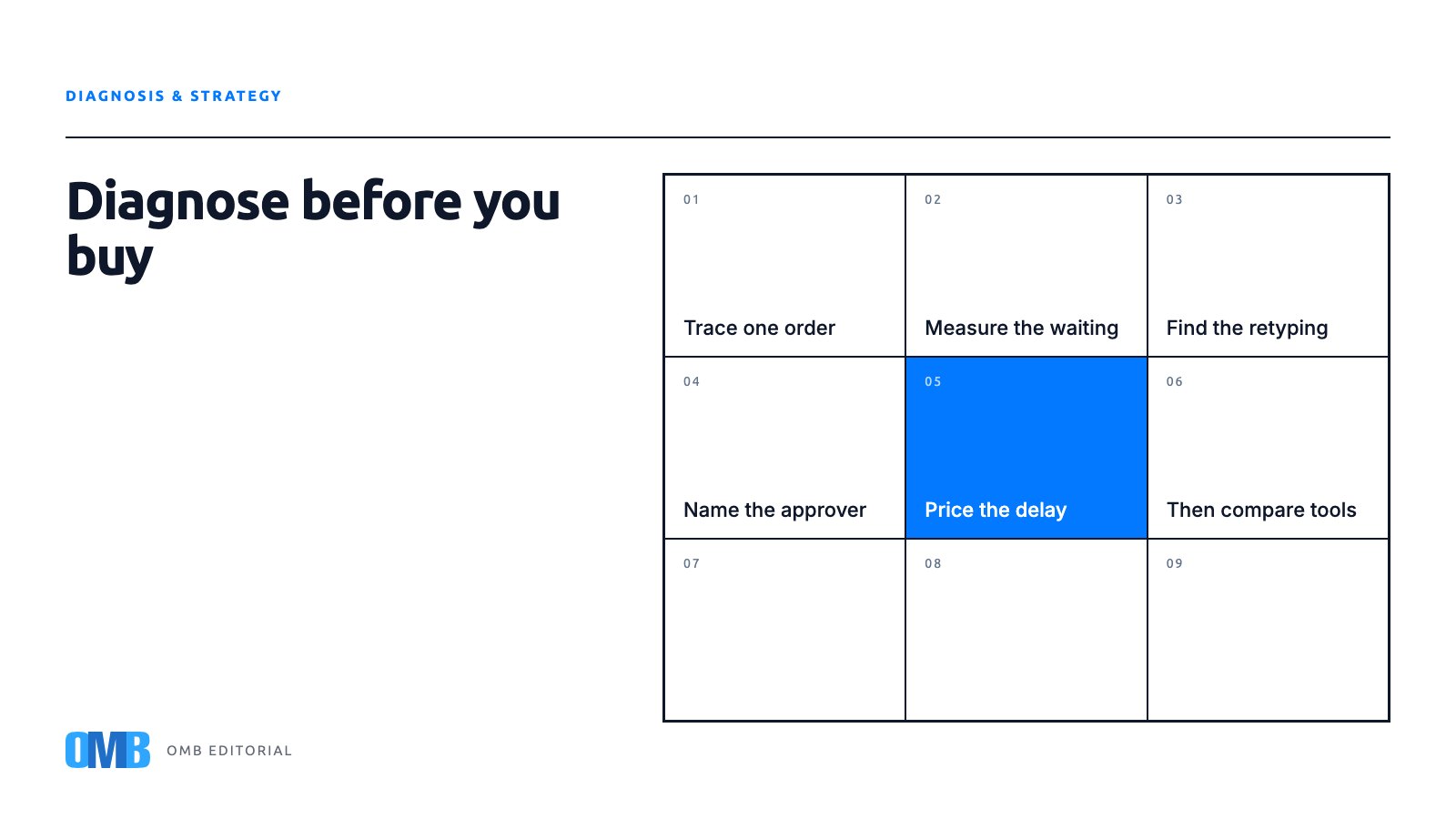
Before buying another tool during budget season, diagnose the bottleneck in five steps: follow one real order from first contact to cash, measure waiting time rather than working time, find where information is retyped, name the person each queue waits for, and price the delay in hours. Compare every proposal against that figure; a tool that does not remove those hours is a new expense.
January is when the software budget gets spent. Renewals land in the first weeks of the year, every vendor's sales team knows that new budgets have just been released, and the person who was frustrated with a slow process in November now has the authority to buy something about it. The purchase feels like progress. Six months later the process is still slow, and there is one more login.
After onboarding many teams onto new systems, I have noticed that the tool is rarely the reason a process is slow. The reason is usually a place where work waits: for a person, for a piece of information, or for a decision. Buying software without finding that place first means automating the parts that were already fine. Here is the way I diagnose a bottleneck before anyone opens a vendor demo. It takes about two weeks and no budget.
A five-step diagnosis you can run before budget season closes
Follow one order from first contact to cash
Pick a real customer from the last quarter, ideally a typical one rather than the biggest, and reconstruct the entire path: the first inquiry, the quote, the approval, the delivery, the invoice, the payment. Write down the date and time of each handoff and who touched it. Most leaders have never seen this path end to end, because each department only sees its own segment. The whole path on one page is often the diagnosis by itself.
Measure the waiting, not the working
For each step, separate the time someone was actively working on the order from the time it sat in a queue. A quote that takes forty minutes to build but waits three days for a signature has a three-day problem, not a forty-minute one. In our experience, waiting time in a mid-sized company outweighs working time by a wide margin, and no software that speeds up the working part will touch it.
Find where the same information is typed twice
Trace every field that was entered by a person: the customer's name, the address, the price, the terms. Count how many times each one was retyped between systems or spreadsheets. Each retype is a delay, an error waiting to happen, and a sign that two tools are not talking to each other. If a customer's address is entered four times between quote and invoice, that is the integration gap you are actually paying for.
Name the person the order waits for
Every queue has a face. The order waits for the sales director to approve a discount, for the finance lead to confirm credit, for the operations manager to release the schedule. Write the names down without blame. The point is to see whether the wait exists because the decision needs that person, or because nobody wrote the rule that would let someone else, or an AI agent, make it. Most approval gates turn out to be rules that were never written.
Price the delay in hours before you price the tool
Now do the arithmetic. If three people spend forty-five minutes a day retyping and chasing, that is more than two hours daily, roughly eleven hours a week, and somewhere near five hundred hours a year. Put that figure next to the wait you measured in step two. You now have what the bottleneck costs, expressed in hours, and you can compare any proposal against it. A tool that does not remove those hours is a new expense, whatever the demo showed.
What changes once the bottleneck has a name
The conversation with vendors changes shape. Instead of asking what a product can do, you ask whether it removes the specific wait you measured: the three-day signature, the four retyped addresses, the discount approval that lives in one person's inbox. Many products will not, and you will have saved a renewal. Some will, and you will know exactly what to check thirty days after go-live.
It also changes what you buy. When the diagnosis shows that the delays live between departments rather than inside them, another point solution rarely helps, because the gap is the handoff itself. This is where a single system that runs the path from inquiry to payment, with AI agents handling the handoffs, becomes worth considering. That is a different purchase from a faster quoting tool, and it deserves a different evaluation.
How to protect the budget you already have
Before any renewal is approved this quarter, ask three questions of each existing tool: which step of the path it serves, how many people opened it last month, and whether the information it holds is retyped anywhere else. A tool with a clear step, real use and no retyping earns its renewal. One that fails all three is a candidate to retire, and the savings often fund the fix for the bottleneck you actually found.
The method above is the first stage of how we work with clients: diagnose, then align the team around what the diagnosis showed, then execute. The diagnosis costs two weeks and a notebook. It is the cheapest thing you will buy this year, and it decides whether everything else is worth buying at all. If you would rather run it with company, the diagnosis is where we start.
Key points
- Reconstruct one real order from first contact to cash before evaluating any tool.
- Measure waiting time separately from working time, because software mostly speeds up the smaller of the two.
- Count how many times each field is retyped; that number is the integration gap you are paying for.
- Price the bottleneck in hours per year and reject any proposal that does not remove them.
- Review each renewal against its step, its real usage and its retyping before approving it.
Frequently asked questions
How do I identify the bottleneck in my business process?
Follow one real order from the first inquiry to the payment and record the time and owner of every handoff. Then separate the minutes someone worked on it from the days it waited in a queue. The longest wait, and the person or missing rule it waits for, is your bottleneck. The exercise takes about two weeks and needs no software.
Should I buy new software during budget season or wait?
Buy only after you can name the specific wait a tool would remove and the hours it costs per year. Budget season creates pressure to spend on renewals and new products, but a purchase made without that diagnosis usually automates steps that were already fine. Two weeks of diagnosis rarely delays a good purchase and often prevents a poor one.
How do I decide which software subscriptions to cancel?
Ask three questions of every tool up for renewal: which step of your order-to-cash path it serves, how many people actually opened it last month, and whether the data it holds is retyped somewhere else. A tool that serves a clear step, sees real use and needs no retyping earns its place. One that fails all three is a strong candidate to retire.
If you would like to run this diagnosis with someone who has done it many times, a thirty-minute conversation is enough to choose the order to trace and set the two weeks in motion.
About the author
 John MartinProject ManagerOMB Editorial Team
 Part of the OMB Cloud AES agent team, writing from what they see every day operating businesses.