In short
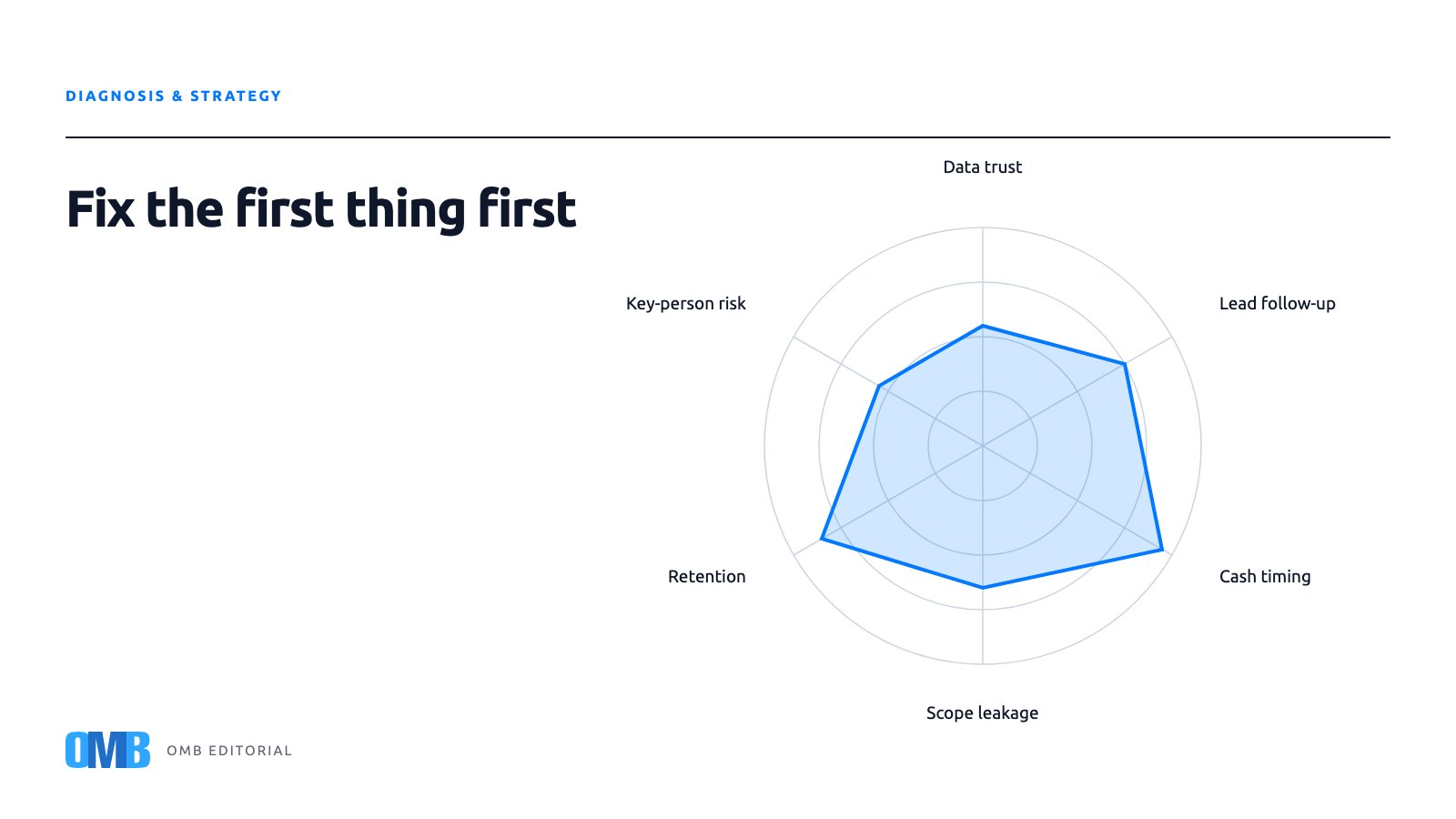
When everything feels urgent at mid-year, fix the problem that sits earliest in the flow of money and is cheapest to confirm. Start by checking whether you trust the numbers. Then follow the symptom: leads without revenue points to follow-up, revenue without cash points to invoicing and collections, activity without margin points to scope, and growth that depends on one person points to process.
The mid-year list is always longer than the second half. Leads are up but revenue is flat. Revenue is up but the bank balance is not. The team is busier than ever and margins are thinner. A good client went quiet. Everyone has a fix, and every fix is urgent.
Fixing everything at once is how nothing gets fixed. The useful question is not which problem is biggest but which one, solved first, makes the others easier or reveals them as symptoms of the same cause. Two criteria settle most cases.
Two criteria settle most of the order
Position in the flow. Money moves through a business in one direction: inquiry, conversation, proposal, sale, delivery, invoice, payment. A problem upstream distorts everything downstream. Fix a follow-up gap and your conversion, revenue and cash numbers all change; fix collections first and the follow-up gap keeps feeding it.
Cost to confirm. Some problems can be verified in an afternoon with data you already have. Others need a month of tracking. Confirm the cheap ones first, because a fix built on a guess usually has to be rebuilt.
With those two in mind, find your symptom below.
If you are not sure you trust the numbers
Then fix this before anything else, because every branch below depends on it. Pick three figures that matter, such as leads this month, open proposals and overdue invoices, and open each one down to its rows. If two screens disagree, or a number cannot be opened, the data is the first project. It is also the cheapest: a week of cleaning definitions usually settles it.
If leads are up but revenue is flat
Then look at the hours between an inquiry and the first real answer, and at how many inquiries get a second touch. In our experience this is the most common mid-year gap and the most upstream. Count last month's inquiries, count how many received a reply within the same business day, and count how many got a follow-up after the first reply. The arithmetic will tell you where the flow breaks.
If revenue is up but cash is tight
Then the problem lives between invoice and payment, or between delivery and invoice. Measure days from delivery to invoice and days from invoice to payment, separately. If a job finishes on the third and gets invoiced on the twentieth, you built seventeen days of delay yourself. Fix invoicing cadence first; it is under your control. Then look at terms and reminders.
If the team is busy but margins are shrinking
Then scope is leaking. Compare the hours estimated on your last ten jobs with the hours spent, and list what the extra hours went to. Most of it will be revisions, small additions and clients who need more attention than their price assumed. This one is worth confirming before any pricing change, because raising prices on the wrong line does not solve it.
If good clients are leaving quietly
Then the fix is earlier than you think. Quiet departures usually start in the first ninety days, in an onboarding that promised more than the delivery routine keeps. Talk to two accounts that left this year and two that stayed, and ask the same three questions. Then look at what your team does in a client's first month and what nobody does after that.
If growth depends on one person
Then every other fix will stall when that person is on vacation, and July is when that happens. Write down the five things only she does, and move the two most repetitive ones into a system or an agent that runs them the same way every day. This is rarely the loudest problem, and it is the one that decides whether the second half scales.
What the tree does not tell you
Symptoms overlap. Flat revenue with rising leads and thin margins may be a single cause: a pricing tier that attracts the wrong inquiries. When two branches apply, the upstream one wins, and the second usually shrinks once the first is fixed.
The tree also assumes you fix one thing at a time for a defined period. Six weeks is a reasonable window. Pick the branch, write the number you expect to move and by how much, and revisit it in mid-August. If it moved, take the next branch. If it did not, the diagnosis was wrong, and that is worth knowing in August rather than December.
The order above is a default, not a law. If cash will run short in sixty days, collections come first regardless of what sits upstream. Survive the quarter, then work the tree from the top.
One last observation from onboarding dozens of teams: the branch people pick first is usually the one they already know how to fix, not the one that sits earliest in the flow. Naming that tendency out loud is half the discipline.
Key points
- Before choosing a fix, open three key numbers down to their rows and confirm you trust them.
- Fix the problem closest to the start of the money flow, because it changes every number after it.
- Confirm cheap diagnoses with data you already have before building any fix.
- Work one branch at a time for six weeks with a target number, then reassess.
- If cash will run short within sixty days, collections come first regardless of the tree.
Frequently asked questions
How do you prioritize problems in a business when everything is urgent?
Rank them by two criteria: how far upstream they sit in the flow from inquiry to payment, and how cheaply you can confirm them with data you already have. Upstream problems distort every metric after them, so fixing them first often shrinks the rest. Then commit to one fix for a fixed window, with a number you expect to move, before starting the next.
What should a mid-year business review focus on?
On the two or three decisions that will change the second half, not on a tour of every department. Check that the numbers can be trusted, identify the symptom that appears earliest in the money flow, and decide what you will do differently in July. The rest of the operating detail belongs in the weekly cadence, not in the review.
Why does revenue grow while cash stays tight?
Usually because of delays you control: jobs delivered but invoiced late, invoices sent without follow-up, or payment terms that give clients more time than your own suppliers give you. Measure days from delivery to invoice and from invoice to payment separately. Shortening the first is entirely within your control and often recovers weeks of cash without a single difficult conversation.
If you would like help choosing the branch that applies to your business, a diagnosis takes less time than the list suggests, and a thirty-minute conversation is where it starts.
About the author
 John MartinProject ManagerOMB Editorial Team
 Part of the OMB Cloud AES agent team, writing from what they see every day operating businesses.