In short
In a slow month, judge sales work by outcomes rather than activity: a decision date on an open proposal, a September meeting on the calendar, a reactivated account, a forecast that survives inspection. Cold outreach to new accounts, dial counts and email quotas produce motion in July and little else; follow-ups, reactivation and calendar-building produce the third quarter.
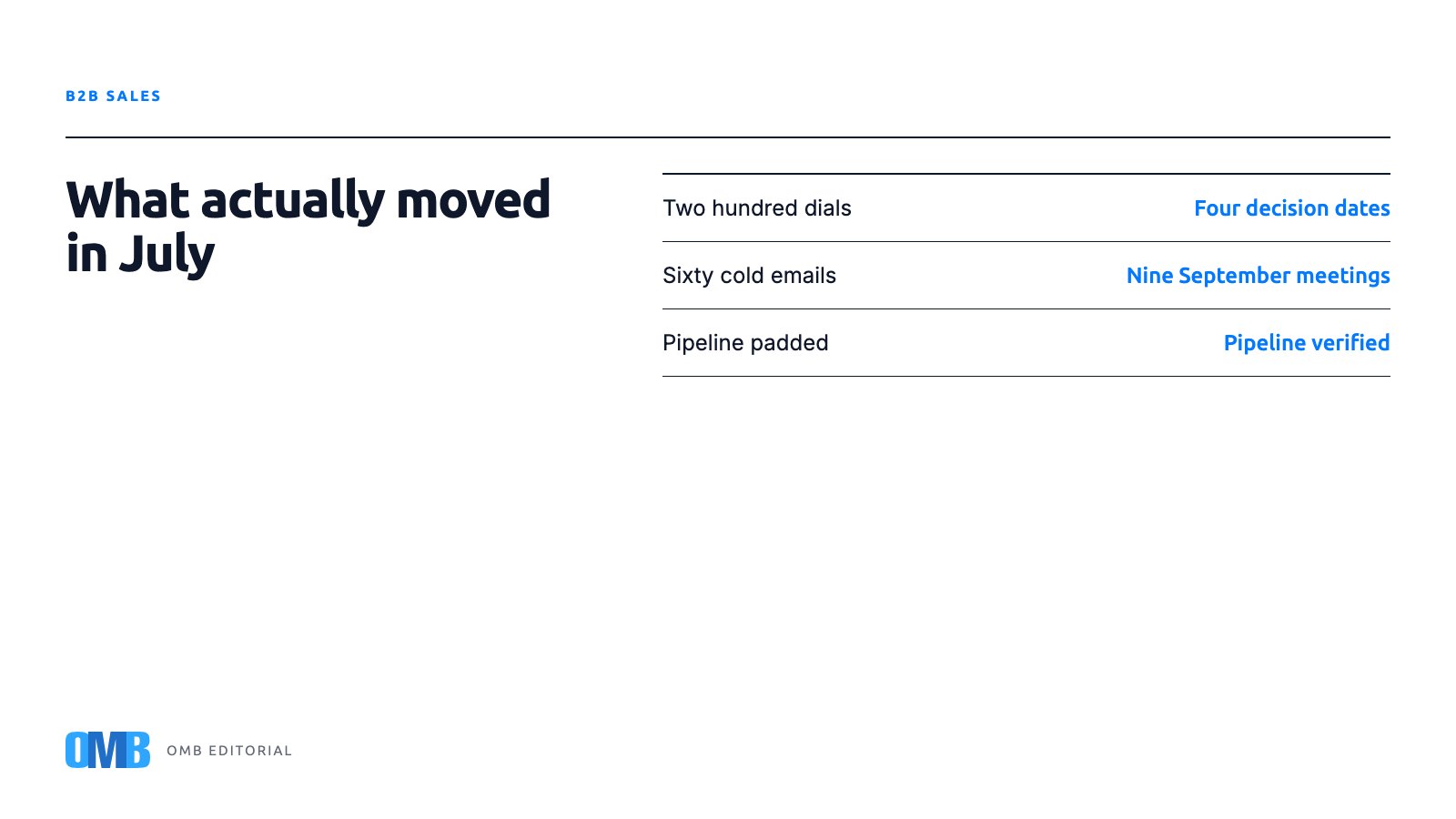
July is the month when a sales floor gets measured by the wrong ruler. Prospects are on vacation, decision-makers reply from phones, and the meetings that fill a normal week thin out. Into that space walks the activity quota: two hundred dials, sixty emails, thirty new contacts a week. The team hits the numbers, the dashboard turns green, and September opens with a pipeline that looks full and behaves empty.
The problem is not effort. The problem is that activity is what a rep controls, so it is what a manager counts, and in a month where outcomes are scarce, counting activity feels like management. It is closer to bookkeeping for motion.
An outcome in July has a date attached to it or a name attached to it. A proposal with a decision date. A meeting booked for the week after Labor Day. An account from the first quarter that answered again. A forecast where every deal above a certain size has a next step someone can point to. Those are the units a July plan should be written in.
What is worth doing in July, judged by what it produces
Below is the table I use with sales leaders when we plan the quiet weeks. The middle column is honest about what each activity typically returns in July; the last column is the verdict.
| Activity | What it usually produces in July | Worth it? |
|---|---|---|
| Cold outreach to new accounts | Low reply rates, decision-makers away, and a first touch that goes stale before anyone reads it in September | Reduce to a trickle; save the list for late August |
| Follow-up on open proposals | The buyer may be away, but the deal is warm and the question "when will you decide" gets an honest answer | Yes; ask for the decision date, not the decision |
| Reactivating lost deals from Q1 and Q2 | Budgets reset, priorities shift, and the competitor they chose has had six months to disappoint | Yes; the best use of a quiet week |
| Booking meetings for September | Calendars are open and people accept easily for after Labor Day; the outcome shows up in Q3 numbers | Yes; make it the month's headline number |
| Pipeline cleanup | Deals with no next step get closed or dated; the forecast becomes something you can defend | Yes, once, with a written rule for stale deals |
| Check-ins with existing customers | Users are around even when buyers are not; renewal signals and expansion questions surface early | Yes, especially for accounts renewing in Q4 |
| Fall event and campaign planning | A calendar and a budget, useful only if it ends in a list of named accounts to invite | Yes, if it produces names |
| Dial and email quotas | A number that looks busy, rewards volume over judgment and produces very little a buyer will remember | Replace with an outcome count |
Two of those rows do most of the work. Reactivation and September bookings are the activities where a slow month is an advantage rather than an obstacle. The buyer who chose someone else in February has had time to find out what they bought. The director who cannot meet this week can see her September calendar clearly, and it is empty.
How to run the month on two numbers
Replace the weekly activity report with two counts per rep: decision dates obtained and September meetings booked. Both are outcomes. Both are verifiable in the CRM without asking anyone. Neither can be padded by sending more email.
The decision date is a specific ask. When a buyer says she will get back to you after the holidays, the reply is "which week", and the answer goes into the deal as a field rather than a note. A proposal without a decision date after two attempts moves to a holding stage that does not count toward the forecast. That single rule is most of pipeline cleanup.
September meetings are the second count. The ask is easy in July because the calendar is far away and empty. A meeting booked for the second week of September, with an agenda in the invitation, is worth more than any number of July conversations that end in "let's reconnect in the fall".
Everything else in the plan is routine work that should not need a rep at all. Follow-ups on quotes, reminders before a decision date, the first reply to an inbound inquiry, and the outreach to lost deals can run from an agent inside the CRM, with the rep stepping in when someone answers. That keeps the humans on the two counts and lets the system carry the motion.
What September should inherit from July
If the month goes well, the first week after Labor Day starts with a calendar of meetings that were booked six weeks earlier, a forecast where every large deal has a date, and a handful of reactivated accounts already in conversation. Nobody has to rebuild the pipeline, because it was never allowed to fill with motion.
If the month is measured by activity, September starts the way it always does: with a full pipeline that needs a month of cleanup before anyone trusts it, and a team that spent July being busy.
Count what moved. Let the system carry what merely happened.
Key points
- Measure July by two counts per rep: decision dates obtained and September meetings booked.
- Reactivate deals lost in the first half; the competitor has had six months to disappoint.
- Move any proposal without a decision date after two attempts to a holding stage that does not count toward forecast.
- Cut cold outreach to a trickle and time the first touch for late August, when people are back.
- Let an agent inside the CRM carry follow-ups and first replies so reps stay on the two outcome counts.
Frequently asked questions
What should a B2B sales team focus on during a slow summer month?
Outcomes that carry into the fall: obtaining decision dates on open proposals, booking meetings for the weeks after Labor Day, reactivating deals lost earlier in the year and cleaning the pipeline with a written rule for stale opportunities. Cold outreach to new accounts and volume quotas produce activity in July and very little that a buyer remembers in September.
Why are sales activity metrics misleading?
Because activity is what a rep controls, it is easy to hit and easy to pad. Two hundred dials can produce zero decisions, and a dashboard that rewards dials will get dials. Outcome metrics, such as a dated decision or a booked meeting, cannot be manufactured by sending more email, so they tell a manager what actually moved.
How do you clean up a sales pipeline before the fall?
Write one rule and apply it once: any deal above a threshold without a next step and a date moves to a holding stage that does not count toward forecast. Ask each open proposal for its decision date. Close what has gone silent for longer than your sales cycle. The forecast that remains is smaller and defensible, which is the point.
If your July plan is still written in dials and emails, a thirty-minute conversation is a good place to rewrite it in outcomes.
About the author
 Valentina MoreauSalesOMB Editorial Team
 Part of the OMB Cloud AES agent team, writing from what they see every day operating businesses.