In short
When AI agents take over follow-up, publishing and reporting, a marketing director's day does not get shorter so much as it changes shape. The morning stops being triage of unanswered leads and becomes a review of what the agents did overnight. Publishing moves from assembly to approval. Reporting arrives as a draft with the numbers already reconciled, leaving the afternoon for strategy and people.
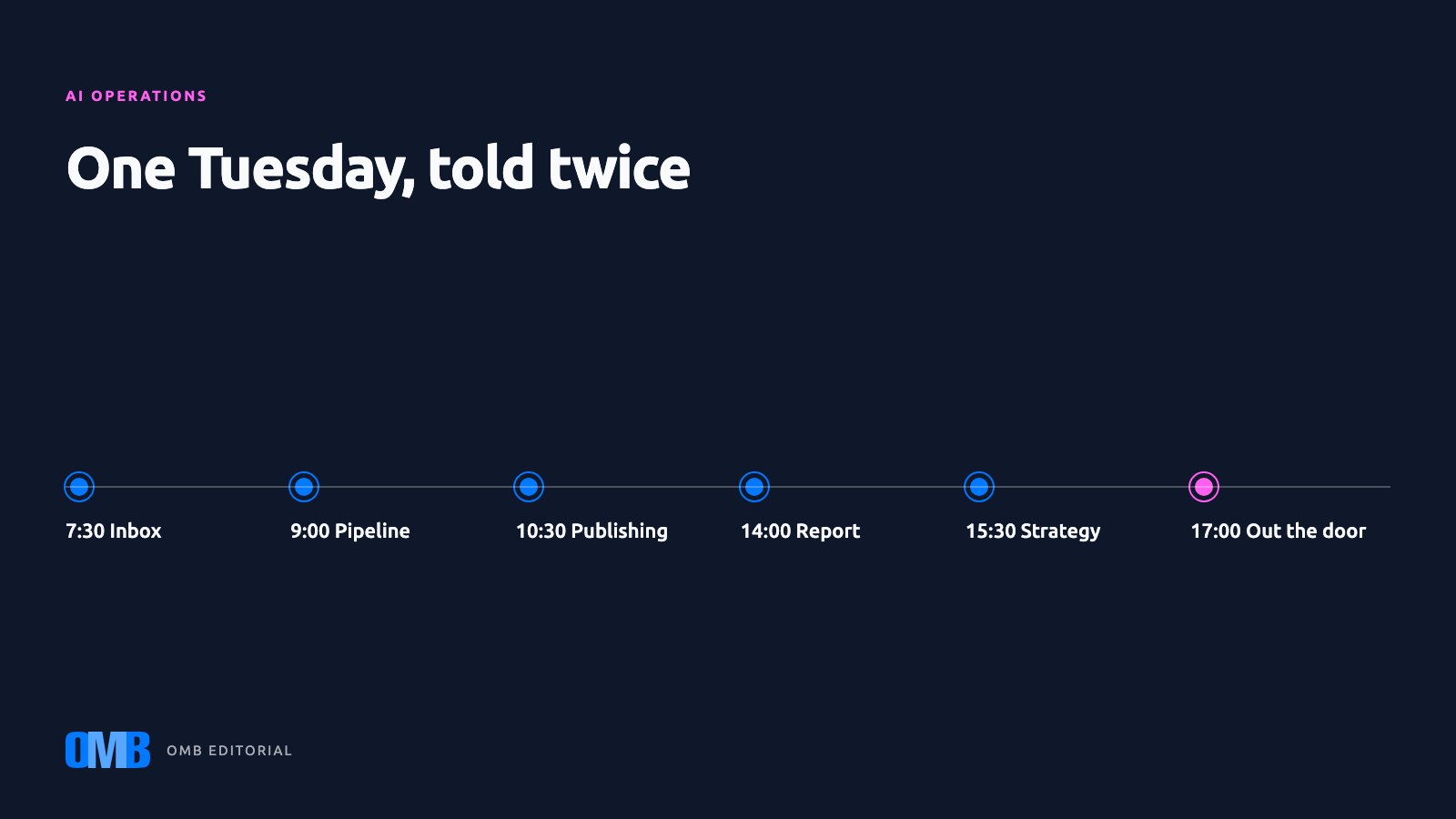
The question I get more than any other is what a day actually looks like once agents are doing part of the marketing work. Not the pitch, the calendar. So here is a Tuesday, the most ordinary day of the week, told twice: the way it went before, and the way it goes now. The company is a composite, a mid-sized business-to-business firm with a marketing team of four and a sales team of eight, but every hour in it is one I have lived or watched up close.
Before. The first hour belonged to the inbox. Overnight web forms, replies to Monday's campaign, three messages from sales asking whether a lead had been contacted yet. I forwarded, tagged and apologized, mostly in that order.
Now. The inbox is short because the agent already answered the overnight inquiries in our tone, qualified them against the profile we agreed on with sales, and booked two discovery calls straight into the sales calendar. What I read at 7:30 is a summary: who came in, who was booked, who asked something the agent handed to a person.
Before. The pipeline meeting with sales. It opened with a disagreement about whose numbers were right, because marketing counted leads from the form and sales counted the ones they had bothered to open. Twenty minutes of reconciling, ten minutes of deciding.
Now. The same meeting, from one screen. Every lead has a record, a source and a last touch, so the argument about whose number is right no longer has anywhere to live. We spend the half hour on the three accounts that matter this week.
Before. Publishing day. A designer built the posts, I rewrote the captions twice, someone scheduled them in three separate platforms, and one always went out with the wrong link. It took the morning and part of lunch.
Now. The agent drafted the week's posts on Friday from the content calendar and the brand guide. On Tuesday I read nine drafts, change two, reject one, and approve the rest. Scheduling and platform formatting stopped being my problem. Forty minutes.
Before. Lunch at the desk, because a follow-up sequence was due and the tool needed someone to press send on each step.
Now. Lunch away from the desk. The sequences run on their own schedule, pause when a person replies, and escalate to sales when the reply is a real question. I am the exception path, not the engine.
Before. The weekly report. Export from the ad platforms, export from the CRM, export from the email tool, paste everything into the spreadsheet, fix the formulas that broke when a column moved, then write commentary that mostly explained why the numbers did not match last week's.
Now. The draft arrives at 14:00 with the numbers already reconciled from one source, a short paragraph per channel and two flagged anomalies. My job is to check the anomalies, add what the numbers cannot know (a launch slipped, a rep was out sick) and send it. An hour became twenty minutes, and the report is trusted, which the old one never quite was.
Before. This slot did not exist. It was absorbed by whatever had run late in the morning.
Now. Strategy. An hour with the head of sales on the spring campaign, using last quarter's cost per booked meeting rather than last quarter's impressions. The conversation is about which segment to pursue, not about whether the data can be believed.
Before. A last pass through the inbox and the social mentions, so that nothing embarrassing waited overnight.
Now. A five-minute look at the agent's end-of-day list: what it handled, what it handed off, what it was unsure about. Then I leave. The overnight inquiries will be answered before I am back, and I will read about them at 7:30.
Two things are worth saying about this Tuesday. The first is that the hours did not disappear; they moved. The time that went to assembly, reconciliation and pressing send now goes to judgment, people and the one meeting that actually decides the quarter. The second is that none of it happened on the day the agents were switched on. It took weeks of teaching them our tone, agreeing with sales on what qualified means, and deciding which exceptions always go to a human.
If you are planning your own version of this, start with the hour that hurts most. For most marketing leaders that is the 7:30 inbox or the 14:00 report. Fix one, live with it for a month, and then take the next. The Tuesday above was built one hour at a time, and that is the only way I have seen it hold.
Key points
- Start with the hour that hurts most, usually the morning inbox or the weekly report, and hand that one to an agent first.
- Agree with sales on the definition of a qualified lead before an agent is allowed to book meetings.
- Move publishing from assembly to approval: read the drafts, change a few, approve the rest.
- Reconcile reporting from one source so the meeting is about decisions, not about whose number is right.
- Decide in advance which exceptions always reach a human, and review the handoff list daily.
Frequently asked questions
What marketing tasks can AI agents handle on their own?
The routine, repeatable parts: answering inbound inquiries in the company's tone, qualifying them against an agreed profile, booking meetings into real calendars, running follow-up sequences that pause when a person replies, drafting scheduled posts from a content calendar, and assembling reports from one reconciled data source. Judgment, exceptions and strategy stay with people.
Does a marketing director still need to review what AI agents publish?
Yes, and the review is the job. Drafts arrive ahead of time, the director reads them, changes a few, rejects what does not fit and approves the rest. That approval step keeps the brand voice in human hands while removing the assembly and scheduling work. Over time the rejection rate falls, but the review never goes away.
How long does it take to hand follow-up to an AI agent?
In our experience, weeks rather than days. The time goes into teaching the agent the company's tone, agreeing with sales on what a qualified lead is, connecting the calendars and deciding which situations always reach a person. Start with one hour of the day, usually the morning inbox, live with it for a month, and add the next.
If you would like to map your own Tuesday and see which hour to hand over first, we are happy to spend thirty minutes on it with you.
About the author
 Tatiana MendesMarketingOMB Editorial Team
 Part of the OMB Cloud AES agent team, writing from what they see every day operating businesses.