In short
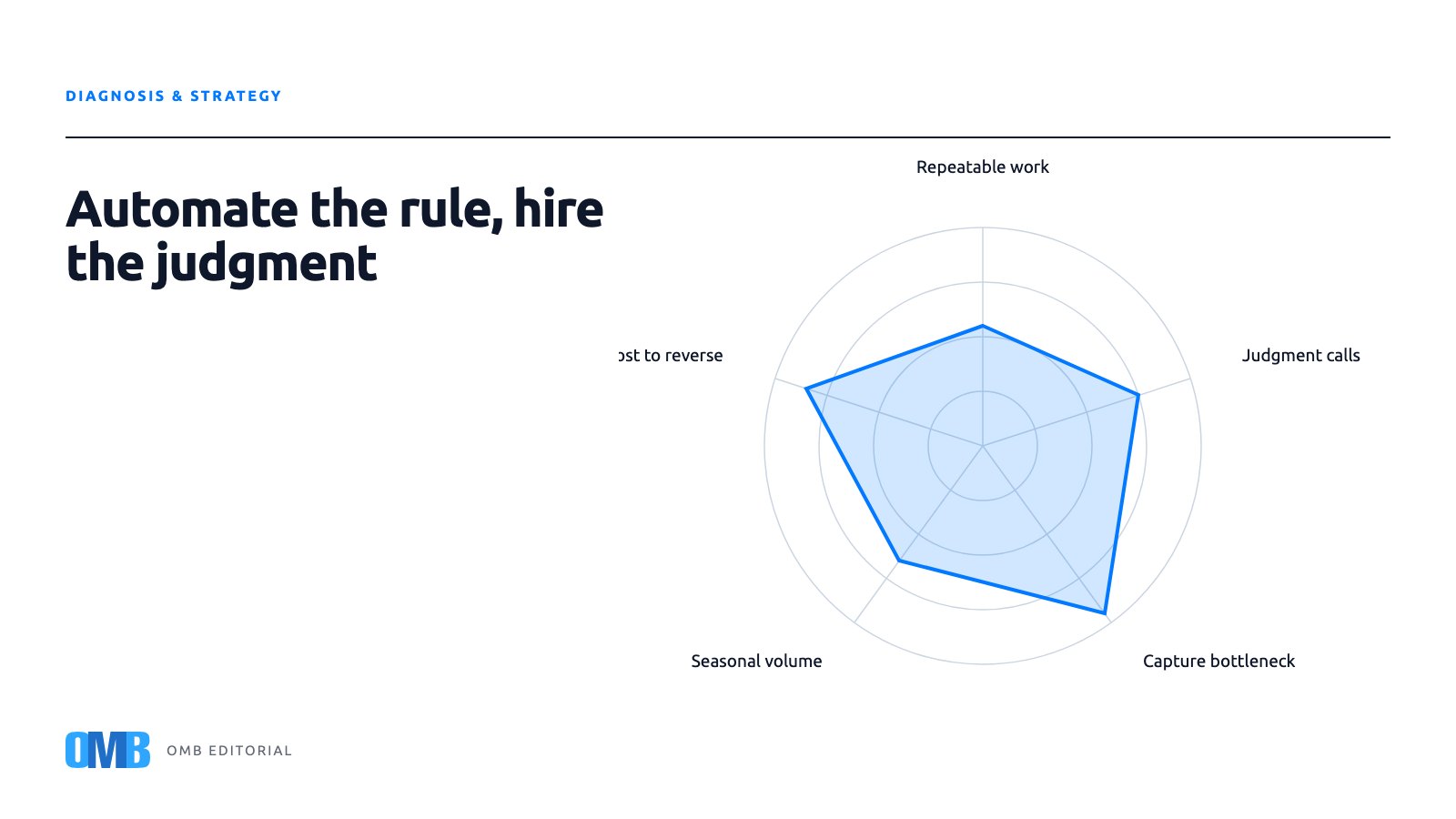
Decide by the type of work that is saturating the team, not by headcount. Repeatable work with clear rules is a candidate for automation. Work that needs judgment usually justifies a hire, once it is separated from the clerical load around it. A capture bottleneck is a systems problem, and seasonal volume calls for elastic capacity rather than permanent salaries.
The last two weeks of a quarter have a way of exposing what the previous eleven hid. Proposals pile up, invoices go out late, the CRM stops matching reality, and someone on your team is working weekends to keep the numbers honest. The instinct at that point is to hire. Sometimes that is right. Often it is a way of paying a salary to a problem that has a cheaper shape.
What should you look at before deciding anything
Saturation is a symptom, and the same symptom has several causes. Before choosing between a person and a system, spend an hour separating the work that is drowning the team into four buckets: work that repeats with clear rules, work that needs a human judgment call, work that is slow only because data has to be captured by hand, and work that spikes for a few weeks and then disappears.
Three questions help sort each task. Can you write the rule that decides it, or does the answer depend on who is asking? Would a competent new hire do it the same way on day one, or does it take a year of context? And does it exist all year, or only when the calendar squeezes?
Two more criteria matter for the money. The first is how long it takes to reverse the decision: a hire made in March is still on the payroll in September, while a system that was configured badly can be reconfigured in an afternoon. The second is where the cost sits. A salary is a fixed cost; a tool is usually a variable one that grows with volume.
A decision tree by type of work
If the work repeats and the rule can be written down
Then automate it before you hire for it. Sending the quote follow-up on day three, moving a lead when a form arrives, drafting the collection reminder on the due date: these are rules, and rules do not need a salary. The test is simple. If you can explain the task to a new colleague in one paragraph without a single "it depends," a system can run it. The person freed from that work is the hire you were about to make.
If the work needs judgment about people or money
Then hire, but hire for the judgment only. Negotiating a renewal, deciding whether a client gets thirty more days of credit, choosing which account deserves the director's visit: this is what experience is for. The mistake is to hire the senior profile and then bury it under the clerical work that surrounds those decisions. Strip that layer out first, and the hire you need is often half a position, or a promotion of someone already in the building.
If the bottleneck is capturing data
Then neither hiring nor automating the downstream step will help, because the delay is upstream. When a rep spends two hours a day typing call notes and updating stages, that is ten hours a week, and a second rep would simply double the typing. The fix is to remove the capture: calls transcribed and summarized into the record, forms landing directly in the pipeline, invoices generated from the accepted quote instead of retyped. Capture is where an agentic enterprise system (AES) earns its place, because the agent does the writing while the person does the talking.
If the volume is seasonal
Then build elastic capacity and refuse the permanent salary. Quarter-end spikes, a trade show month, the weeks before a fiscal year closes: these are predictable and short. Contractors, a temporary reassignment, or an AI agent that handles the first response and the routine follow-up while the team handles the rest cover the peak without leaving you overstaffed in the quiet months. Measure how many weeks a year the spike lasts; if it is under twelve, a fixed hire is expensive insurance.
If you cannot tell which bucket the work belongs to
Then diagnose before you spend. A team that says "we are drowning" rarely knows in which water. One week of logging where the hours go, by task rather than by person, usually shows that two or three activities account for most of the overflow. That log is worth more than any interview with a candidate, because it tells you whether you are buying capacity or buying a workaround.
Where the tree gets blurry
Real work rarely sits cleanly in one branch. A collections process is repeatable for the first two reminders and pure judgment by the fourth conversation. Treat it as two tasks: automate the front, staff the back. The same split applies to lead follow-up, onboarding, and most of what a sales operations person does today.
Automation also changes the profile you hire. Once the routine layer runs on its own, the person you need is more senior and more comfortable supervising a system than executing a checklist. Budget for that, because it is a different salary band and a different job description.
The team's fear is legitimate, so name it. Nobody was hired to be replaced by a rule. The honest framing is that the rule takes the part of the job nobody wanted, and the quarter-end weekend is the first thing to disappear. In our experience, the teams that adopt fastest are the ones that were given back their evenings first.
The quarter is ending either way. What you decide in the next two weeks determines whether the next one ends the same way, or with a team that is busy for better reasons. If you want a second pair of eyes on which bucket your overflow belongs to, a short diagnosis is where we usually start.
Key points
- Sort the overflow by type of work before comparing a salary to a subscription.
- Automate the tasks whose rule fits in one paragraph, and hire only for the judgment that remains.
- Treat a capture bottleneck as a systems problem; a second person only doubles the typing.
- Cover seasonal spikes with elastic capacity and measure how many weeks a year they last.
- Log a week of hours by task before you open a job requisition.
Frequently asked questions
Should I automate or hire when my team is overloaded?
Start with the type of work, not the headcount. Repeatable tasks with a written rule are cheaper and faster to automate. Work that depends on judgment about people or money justifies a hire, once the clerical work around it is removed. Seasonal spikes call for temporary or elastic capacity, and a capture bottleneck is solved by connecting systems rather than by adding people.
How do I know if a task can be automated?
Try to explain the task to a new colleague in a single paragraph. If you can describe the trigger, the rule and the outcome without saying "it depends," the task is a candidate for automation. If the explanation needs context about specific clients, history or negotiating room, it needs a person, at least for the part that carries the judgment.
What does automation cost compared with a new hire?
A hire is a fixed cost that continues whether volume is high or low, plus recruiting time and onboarding. Software is usually a variable or subscription cost that scales with use and can be reconfigured or cancelled quickly. The comparison that matters is per task: what it costs to have a rule run a hundred times versus what it costs a person to do it a hundred times.
If you would like a second opinion on which bucket your quarter-end overflow belongs to, we are glad to spend thirty minutes looking at it with you.
About the author
 Roger VegaTechnologyOMB Editorial Team
 Part of the OMB Cloud AES agent team, writing from what they see every day operating businesses.