In short
A mid-year review changes decisions when it starts from the two or three bets you made in January, compares each one against evidence, and ends with a written change: a budget moved, a line paused, a hire brought forward. Most reviews become a slide deck because they report activity instead of testing bets, and because nobody owns the correction afterward.
By the end of June, half the year is on the books. The plan you wrote in January has met six months of customers, hires, pricing calls and weather you did not forecast. A mid-year review exists for one reason: to decide what you will do differently in the second half, with the evidence of the first.
Most reviews do not do that. They produce a deck. The deck is accurate and complete. It gets presented, nodded at, filed. In July, the business runs the way it ran in May.
A review is a test of bets, not a report of activity
Every plan is a small set of bets. You bet that a new service line would carry its own weight by summer. You bet that a second salesperson would pay for herself in five months. You bet that raising prices on the lowest tier would lose fewer accounts than it gained in margin. Three or four bets, rarely more, carry most of the year.
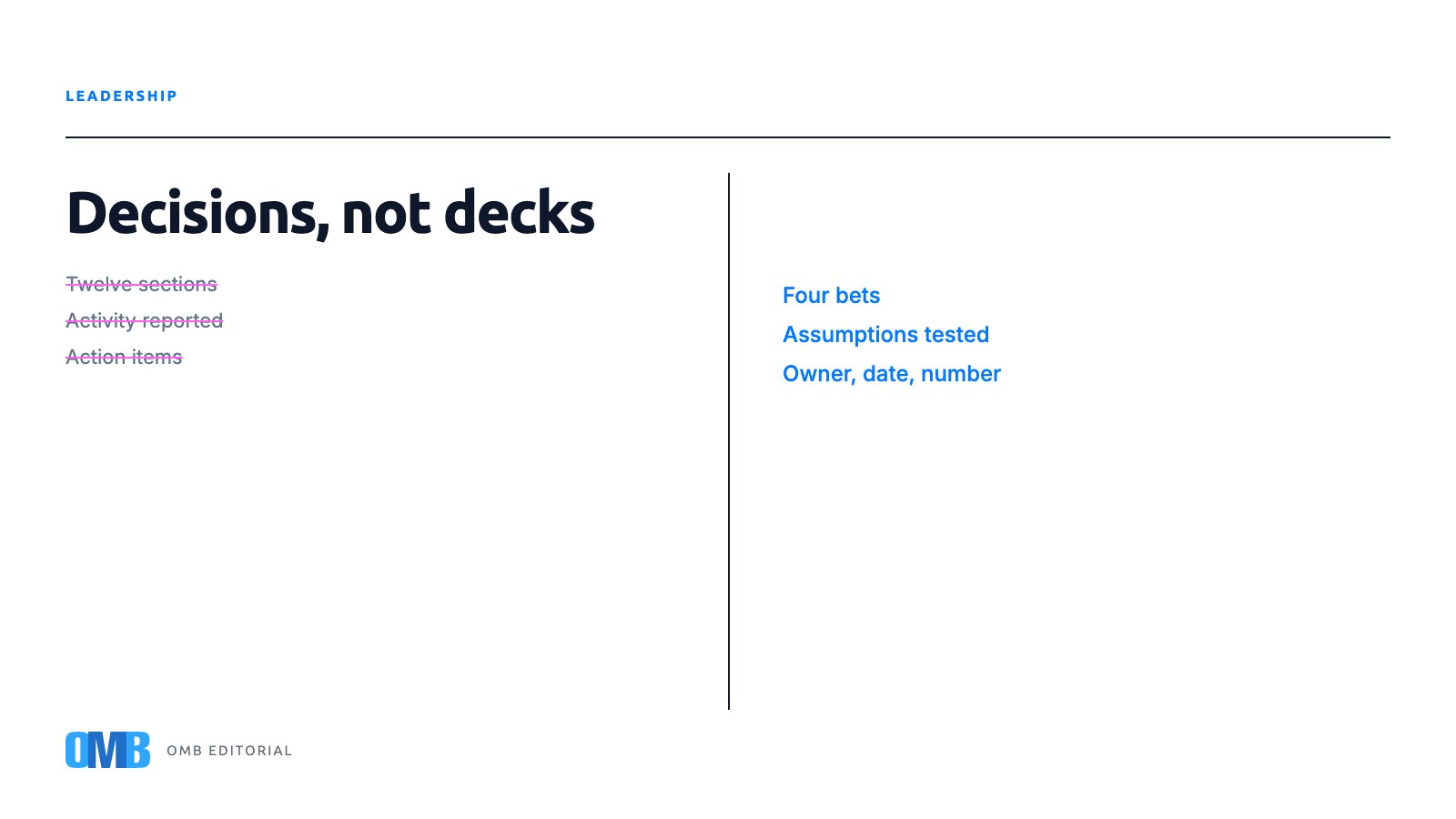
A review that changes decisions starts by naming those bets out loud and asking, one at a time, whether the evidence supports them. That is a different exercise from reporting activity. Activity says what the team did. A bet says what you expected to happen, and the review says whether it happened.
The distinction matters because activity is always defensible. Every department did things. A bet can be wrong, and a wrong bet is the only thing a review can act on.
Why the deck wins by default
The deck wins for reasons that have little to do with laziness. The first is ownership. Each leader prepares her section, and each section is written to explain, not to question. Nobody in the room owns the whole plan, so nobody owns the correction.
Next comes the shape of the data. Dashboards show totals: revenue, pipeline, headcount, spend. Totals hide the bets. If the new line is losing money and the legacy line is over-performing, total revenue can look exactly on plan while both bets are wrong in opposite directions.
And there is the calendar. The review lands in the same week as quarter-end closing, vacations and the second-half budget. A decision needs a person, a date and a number attached. A slide needs only a slide.
A slide can be accurate and still change nothing. A correction has a name, a date and a number on it.
Three questions force a decision
You can run the review in ninety minutes if you replace the departmental tour with three questions applied to each bet.
What did we expect by now? Write the January number next to the June number. If the plan said the new line would bill a certain amount per month by June and it bills half that, say so in one line.
What do we know now that we did not know then? Sometimes the bet was right and the execution was slow. Sometimes the market answered a question you did not ask. A service line that sells well to one segment and poorly to every other is not a failure; it is a narrower bet than the one you made.
What would we do if we were placing this bet today? This is the question the deck never asks. If you would not fund the line now, you should not keep funding it because you funded it in January. If you would double the salesperson, do it in July, not in the next annual plan.
In our experience, leaders who write the answers to these three questions on a single page, one bet per row, leave the room with decisions. Leaders who present twelve sections leave with action items.
What changes the morning after
A review passes its test when something is different on the first Monday of July. A budget line moved. A hire brought forward or a search paused. A price change scheduled with a date. A line kept, with a specific number it must hit by September to stay funded.
Each of those needs an owner and a checkpoint, and the checkpoint should be visible in the same system where the work happens, not in a deck that nobody reopens. If your CRM, invoicing and marketing live in one place, the checkpoint can be a number the system shows you every week, without anyone preparing it. That is the practical difference between a review and an event.
There is a quieter benefit. When the team sees that the mid-year review moved money and changed priorities, the next plan gets written more honestly. People stop writing bets they do not believe, because they know someone will come back in June and check.
Half a year is enough evidence to correct with, and enough runway to make the correction count. Use the review for the decision, and let the deck be the record of it rather than the substitute.
Key points
- Start the review from the three or four bets in the January plan, not from departmental reports.
- Put the expected number and the actual number side by side for each bet, one line each.
- Ask what you would do if you were placing each bet today, and act on the answer in July.
- Give every correction an owner, a date and a checkpoint that lives where the work happens.
Frequently asked questions
How long should a mid-year business review take?
Ninety minutes is enough if the review is organized around the plan's main bets rather than a tour of departments. Prepare one page with each bet, the number expected by June, the actual number and the proposed change. The meeting then spends its time on decisions, and the supporting detail stays available for anyone who wants it afterward.
What should a mid-year review cover for a mid-sized company?
Cover the few decisions that carry the year: new lines, key hires, pricing moves, major spend. For each, compare the expected result with the actual result, note what you learned, and decide whether to continue, adjust or stop. Leave routine operating metrics to the weekly cadence so the review stays focused on course corrections.
Why do mid-year reviews fail to change anything?
Usually because they report activity instead of testing assumptions, because no single person owns the whole plan, and because decisions leave the room without an owner, a date and a number. Fixing those three things, bets instead of activity, one owner per correction and a visible checkpoint, turns the review into a decision point.
If you want a second pair of eyes on your first-half numbers before you decide, a thirty-minute conversation is a good place to start.
About the author
 Anna LaurentExecutive AssistantOMB Editorial Team
 Part of the OMB Cloud AES agent team, writing from what they see every day operating businesses.